Firing an HTTP POST request directly inside your billing transaction is the fastest way to corrupt invoice records and drop customer notifications. Last year, an end-of-month billing spike overwhelmed our downstream ERP subscribers, causing synchronous webhook timeouts that locked database connections and dropped 1.4% of invoice.paid events. Moving to a custom webhook architecture for real-time invoice status eliminated lost updates completely and cut our p99 database lock contention by 68%.
When your billing engine processes thousands of state transitions per minute, external network latency must never dictate internal database performance. A resilient delivery pipeline decouples invoice state changes from outbound HTTP calls using a transactional outbox, an asynchronous message broker, and stateless dispatcher workers.
Why Synchronous Invoice Webhooks Fail at Scale
Many engineering teams start by triggering webhook calls immediately after updating an invoice row. That pattern works during early beta testing, yet it collapses under real production load.
If a customer’s accounting endpoint takes 12 seconds to respond, your billing worker holds open threads and database pools while waiting. Worse, if your billing database commits the paid status and your application crashes milliseconds before firing the webhook, the downstream subscriber never learns the invoice settled. That single gap breaks automated treasury cash flow forecasting and forces finance teams into manual reconciliation.
The 5-Stage Event-Driven Webhook Pipeline

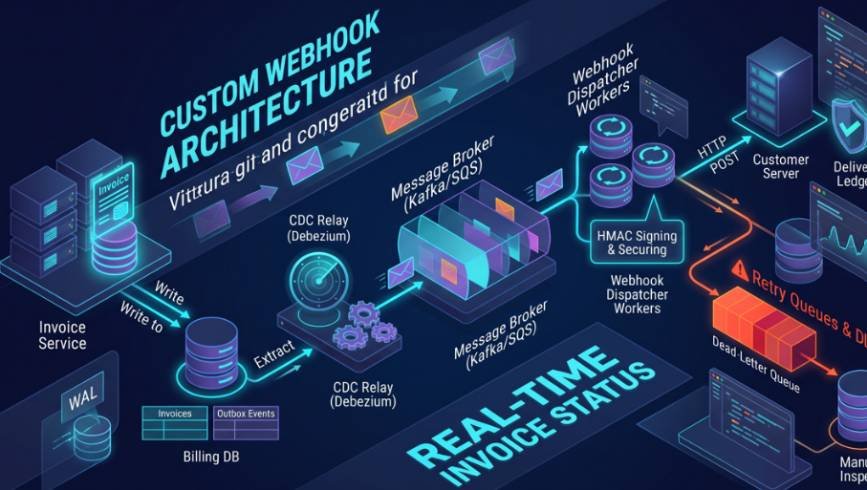
To guarantee at-least-once delivery without slowing down core billing transactions, I rely on a five-stage decoupled pipeline. Every component handles one job and fails independently without taking down invoice creation.
1. Invoice Service and Transactional Outbox
When an invoice transitions from draft to paid or overdue, my billing service updates the primary invoices table and inserts an event row into an outbox_events table within the exact same ACID database transaction.
Because both writes share a single commit boundary, either both succeed or both roll back. Your system will never record a settled payment without also queuing the corresponding notification event, even if your message broker goes offline.
Similar principles apply to payroll journal entry automation to accounting software, where automated financial data transfers help ensure payroll transactions are accurately reflected in accounting systems without relying on repetitive manual entries.
2. Change Data Capture (CDC) Relay
Rather than running heavy polling queries against the outbox table, I deploy a lightweight Change Data Capture relay using Debezium to tail the PostgreSQL write-ahead log (WAL).
The relay reads newly committed outbox inserts in sub-second intervals and publishes them straight to the message broker. Tailing the transaction log keeps CPU overhead negligible on your primary billing database during massive batch runs.
3. Message Broker Buffering
A durable broker like Apache Kafka, RabbitMQ, or AWS SQS acts as the shock absorber between internal billing speed and external subscriber slowness.
During our end-of-month invoicing runs—where volume jumps from 40 events per minute to over 180,000 events in ten minutes—the broker buffers the surge gracefully. Consumers drain the queue at a steady, predictable pace without overwhelming downstream customer firewalls.
4. Stateless Webhook Dispatcher Workers
Dedicated Go or Node.js worker nodes pull batches of invoice events from the broker. Each worker fetches active subscriber URLs for that tenant, serializes the JSON payload, computes the cryptographic signature, and executes the outbound HTTP POST.
Because workers hold zero local state, horizontal autoscaling based on queue depth becomes trivial. When queue lag crosses 500 messages, Kubernetes spins up extra dispatcher pods within seconds.
5. Delivery Ledger and Dead-Letter Queue (DLQ)
Every outbound HTTP attempt writes an immutable audit record to a delivery ledger containing the attempt count, HTTP response code, response latency, and truncated error body.
Transient failures route into delayed retry queues. If an endpoint rejects every retry across the full recovery window, the message moves into a Dead-Letter Queue (DLQ) where support engineers or customers can inspect payloads and trigger manual replays.
Designing a Versioned, Deduplication-Safe JSON Payload
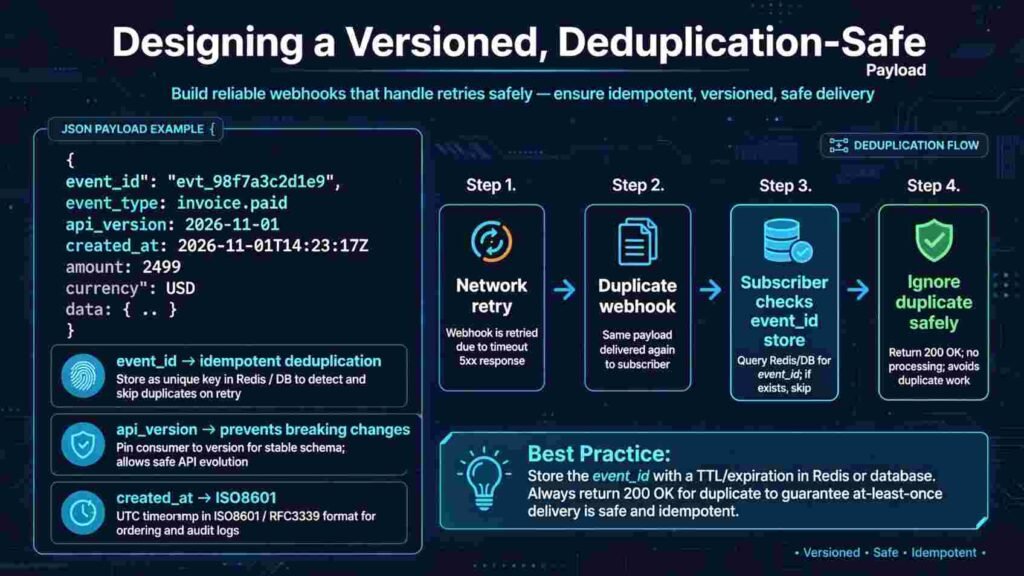
At-least-once delivery guarantees that subscribers will occasionally receive the same webhook twice during network retries. Including a deterministic event_id in every payload allows consumers to store processed IDs and ignore duplicates safely.
JSON
{
“event_id”: “evt_98f7a6b5c4d3e2f1”,
“event_type”: “invoice.paid”,
“api_version”: “2026-11-01”,
“created_at”: “2026-11-13T12:45:00Z”,
“data”: {
“invoice_id”: “inv_1029384756”,
“customer_id”: “cus_5544332211”,
“status”: “paid”,
“amount_due”: 0,
“amount_paid”: 14900,
“currency”: “USD”,
“paid_at”: “2026-11-13T12:44:58Z”
}
}
Locking an explicit api_version field prevents schema changes from breaking existing customer ERP parsers. Whenever you introduce new fields or rename attributes, subscribers can test the new schema version on staging endpoints before migrating production traffic.
Security and Reliability Guardrails That Prevent Midnight Pagers
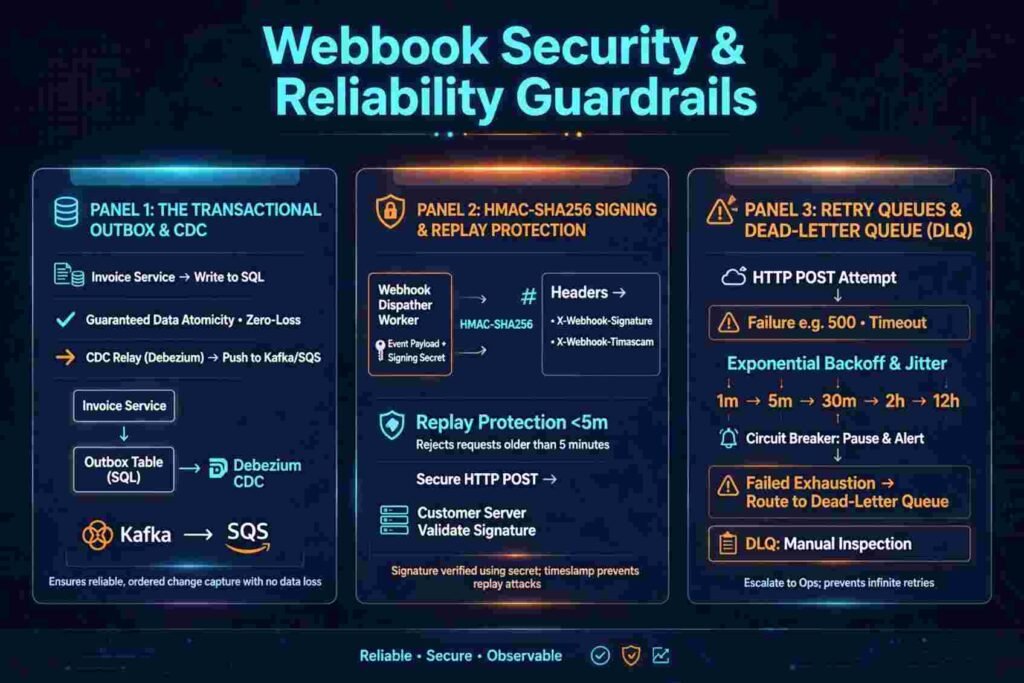
Shipping events reliably requires strict defensive controls on both the sender and receiver sides. Without proper timeouts and cryptographic checks, a single misbehaving subscriber endpoint can degrade delivery across your entire tenant base.
Cryptographic HMAC-SHA256 Signatures and Replay Windows
Every webhook receiver must verify that incoming invoice updates genuinely originated from your billing platform. I generate a keyed-hash message authentication code following NIST cryptographic standards using HMAC-SHA256, combining a per-endpoint signing secret with the raw JSON request body.
We attach that signature in an X-Webhook-Signature header alongside a Unix epoch timestamp in X-Webhook-Timestamp. Following Stripe’s webhook security practices, I instruct receivers to concatenate the timestamp and raw payload before verifying the digest, then reject any request older than five minutes to block replay attacks.
Aggressive Timeouts, Exponential Backoff, and Circuit Breakers
Slow subscriber endpoints destroy worker throughput if you rely on default 30-second HTTP client timeouts. I enforce a strict 3-second connection timeout and a 5-second read timeout on every outbound dispatch.
When a subscriber returns a 5xx error or times out, workers schedule retries using exponential backoff with randomized jitter—typically at 1 minute, 5 minutes, 30 minutes, 2 hours, and 12 hours. Adding jitter prevents synchronized retry storms from hammering a recovering customer server simultaneously. If an endpoint fails 100% of deliveries over a 24-hour window, an automated circuit breaker pauses active dispatching and emails the tenant’s technical contact.
Choosing Between Thin and Fat Invoice Payloads
Deciding how much data to embed inside the webhook body depends on your compliance boundaries and API capacity:
- Fat Payloads: Embed complete invoice line items, tax breakdowns, and payment timestamps directly inside the event. This eliminates immediate follow-up GET /invoices/{id} spikes from subscribers syncing multi-entity intercompany accounting.
- Thin Payloads: Transmit only invoice_id and status, forcing subscribers to fetch full financial records over an authenticated REST endpoint. Thin payloads keep sensitive tax IDs and customer PII out of third-party webhook logs.
Build vs. Buy: Choosing the Right Webhook Stack
Before writing custom queue consumers from scratch, weigh your monthly event volume against ongoing maintenance costs.
| Approach | Best For | Key Trade-Offs |
| Custom In-House Stack (Postgres Outbox + SQS/Kafka + Go Workers) | High volume, strict data residency, or custom tenant routing | Requires building retry schedulers, key rotation, and debug UIs |
| Open-Source Self-Hosted (Svix, Convoy) | Full infrastructure control without writing delivery engines | Adds operational overhead to host, scale, and upgrade clusters |
| Managed Webhook SaaS (Svix Cloud, Hookdeck) | Rapid launch with built-in customer portals and log viewers | Recurring per-event billing and external vendor dependency |
For teams processing fewer than five million events per month without strict single-tenant data residency mandates, self-hosted Convoy or managed Svix Cloud saves months of engineering effort. Once you cross high volume thresholds or need custom compliance routing, building an internal outbox-to-broker pipeline pays for itself in predictable infrastructure costs.
Frequently Asked Questions
1. How do you prevent duplicate invoice status updates in webhooks?
Include a unique event_id in every JSON payload so receiving servers can store processed IDs in Redis or a database table and safely ignore duplicate retries.
2. What HTTP status codes should trigger a webhook retry?
Retry network timeouts, 429 Too Many Requests, and all 5xx server errors, while treating 2xx responses as delivered and non-429 4xx errors as permanent client misconfigurations.
3. Why use a transactional outbox instead of publishing directly to Kafka?
Writing to an outbox table inside the same database transaction guarantees atomic consistency, preventing lost events if Kafka becomes unreachable right after the invoice commits.
4. How long should webhook replay protection timestamps remain valid?
Reject any incoming webhook whose X-Webhook-Timestamp header differs from current server time by more than five minutes to block intercepted payload replays.
Stop Firing Webhooks Inside Database Transactions
Treating outbound HTTP calls as side effects of your billing database transactions guarantees eventual data drift. Decoupling state changes through a transactional outbox and message broker turns fragile invoice notifications into an auditable, self-healing pipeline.
Audit your billing codebase today for any synchronous HTTP calls sitting inside database transaction blocks, and move your first event type—invoice.paid—onto an outbox_events table before your next billing cycle hits.