
Two years ago, our corporate treasury team spent every Monday morning downloading CSV files from six regional banking portals just to build a 13-week liquidity view. By the time we reconciled those files against our ERP, intraday wire transfers had already made our cash position obsolete. Building a treasury cash flow forecasting api data pipeline eliminated that lag and cut our 30-day variance from 11% down to 2.4%.
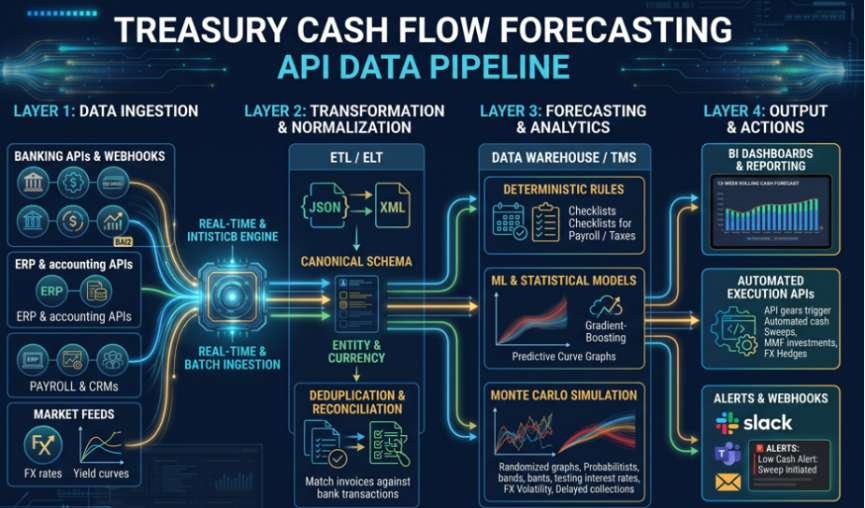
A modern pipeline replaces fragile manual spreadsheets with automated data ingestion, strict schema normalization, and predictive modeling. Here is the exact four-layer architecture I use to turn fragmented financial feeds into real-time liquidity decisions.
Layer 1: Multi-Source Financial Data Ingestion
Every reliable forecast starts with clean, timely inputs. Rather than pulling everything on a single nightly cron job, I split our ingestion layer into event-driven streams and scheduled batch extracts.
Integrating automated payment gateway settlement reconciliation alongside accounts receivable and ERP endpoints helps ensure that incoming customer payments, settlement records, and outstanding invoices are accurately reflected in the treasury cash flow forecast.
Real-Time Bank Connectivity and Market Feeds
We pull intraday balances, cleared transactions, and prior-day statements directly from banking partners using Open Banking standards and direct bank APIs. With instant payment rails like the Federal Reserve FedNow Service enabling round-the-clock liquidity transfers, waiting until the next morning for a BAI2 file leaves dangerous blind spots. Alongside bank feeds, we ingest live foreign exchange (FX) spot rates and yield curves every 15 minutes to value multi-currency cash pools accurately.
ERP, Payroll, and Operational APIs
Bank balances only show where cash sits right now. To see where cash goes next, our pipeline queries REST APIs across internal operational platforms:
- ERP & General Ledger: Extracts open purchase orders, scheduled accounts payable (AP) runs, and open customer invoices.
- Billing & CRM: Captures upcoming subscription renewals and high-probability sales pipeline closes.
- HRIS & Payroll: Pulls exact net pay runs, tax withholdings, and benefit disbursements days before settlement.
Integrating these endpoints alongside automated accounts receivable workflows ensures our pipeline captures invoice creation the second a bill goes out the door.
Layer 2: ETL/ELT Normalization and Schema Mapping
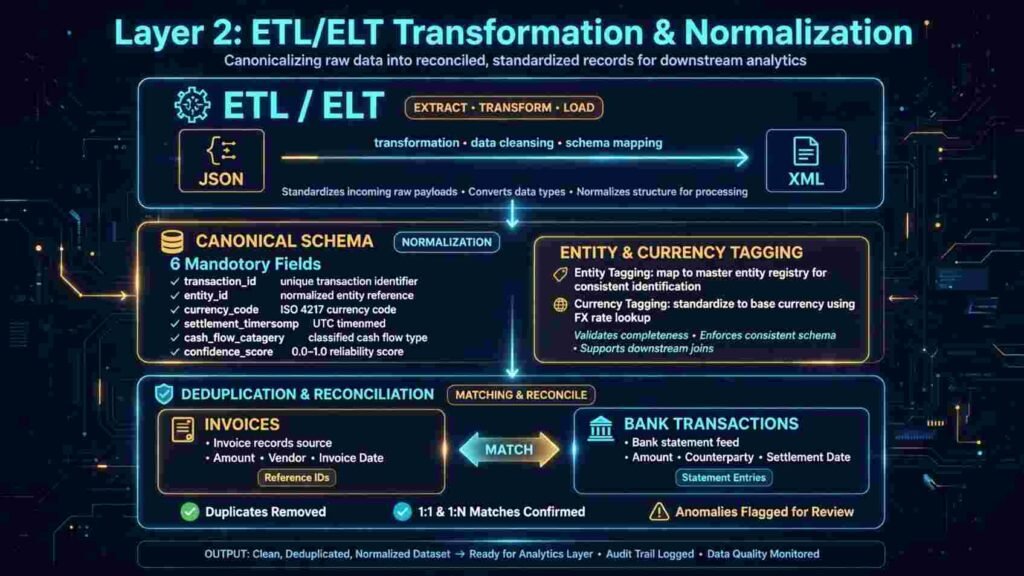
Raw financial payloads never match out of the box. One commercial bank sends nested XML, another delivers flat text files, and your ERP exports proprietary JSON. Dumping raw payloads straight into a warehouse guarantees broken downstream queries.
Standardizing ISO 20022 and BAI2 Payloads
Inside our transformation layer, we map every incoming bank message—whether legacy BAI2 or modern ISO 20022 cash management definitions like camt.053 and camt.054—into a single canonical schema. Every normalized record requires six mandatory fields before entering our warehouse: transaction_id, entity_id, currency_code, settlement_timestamp, cash_flow_category, and confidence_score.
Entity Tagging and Deduplication Rules
Once mapped, our transformation scripts tag each record by legal entity, business unit, and operating, investing, or financing bucket. If you manage complex subsidiaries, connecting this step to your multi-entity intercompany accounting rules prevents internal treasury sweeps from masquerading as external revenue.
We also run strict deduplication logic here. When a customer wires $150,000, the bank webhook fires immediately while the ERP invoice stays marked “open” until the nightly batch sync. Our pipeline matches incoming bank reference IDs against open ERP receivables and automatically suppresses the open invoice forecast so we never double-count the same dollar.
Layer 3: Hybrid Liquidity Forecasting Models
With normalized data sitting in our cloud warehouse and Treasury Management System (TMS), we run a hybrid modeling engine. Relying purely on machine learning fails for fixed obligations, while rigid rules miss customer payment delays.
Deterministic Rules vs. Predictive Machine Learning
We separate cash flows by predictability and apply distinct logic to each bucket:
| Cash Flow Type | Modeling Method | Data Inputs Used |
| Payroll, Taxes & Debt Service | Deterministic Rules | Exact HRIS schedules, tax calendars, and loan amortization tables |
| Accounts Receivable (AR) | Gradient-Boosted ML | Historical customer DSO, invoice size, dispute flags, and seasonality. |
| Discretionary OpEx & CapEx | Rolling Statistical Average | Trailing 90-day department spend velocity and open PO approvals. |
Instead of trusting the “due date” printed on an invoice, our ML model assigns a probability distribution across future weeks based on how late each specific buyer actually pays.
Monte Carlo Stress Testing for Rate and FX Volatility
Static forecasts break the moment macro conditions shift. Every night, our analytics engine runs 5,000 Monte Carlo simulations across our baseline forecast. We stress-test sudden 50-basis-point interest rate shifts, 4% swings in EUR/USD exchange rates, and a 15-day stretch in customer collections. This gives our CFO a clear statistical floor for minimum operating cash buffers.
Layer 4: Automated Treasury Actions and BI Reporting

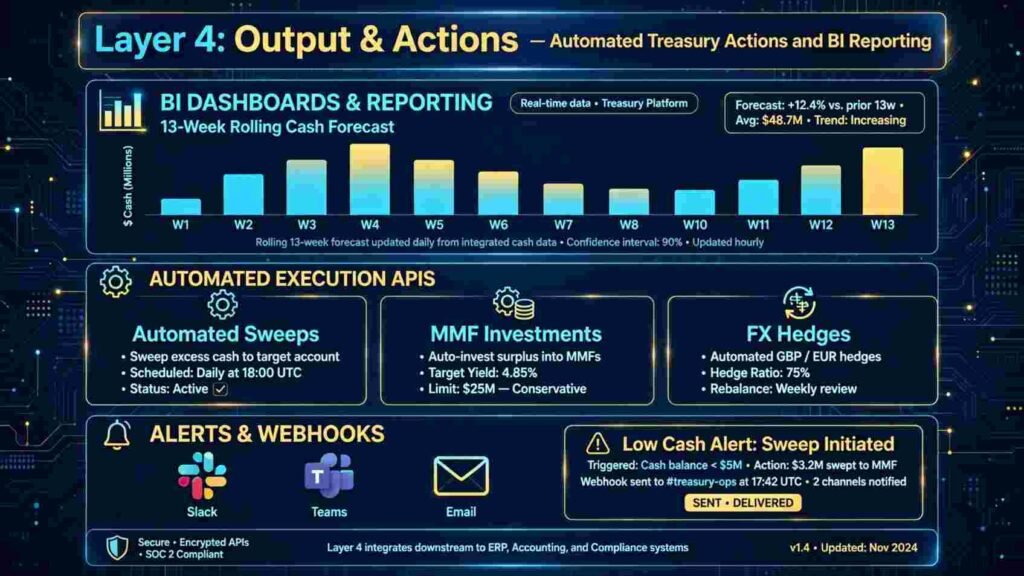
A forecast has zero value if it sits trapped inside a data warehouse. Our final pipeline layer pushes 13-week rolling forecasts and daily cash positions directly into Power BI dashboards for executive review.
More importantly, we close the loop with execution APIs. As highlighted in the McKinsey 2026 Global Payments Report, autonomous treasury workflows increasingly sweep idle cash into higher-yielding instruments automatically.
When our pipeline projects a surplus above $2 million for more than five days, an API trigger initiates an automated sweep into overnight money market funds via our TMS—mirroring capabilities found across leading platforms tracked in Gartner Treasury Management Systems reviews. Conversely, if projected liquidity dips below our safety threshold, a webhook immediately alerts our treasury Slack channel.
Two Architectural Traps That Break Production Pipelines
Even well-funded engineering teams hit predictable roadblocks when connecting treasury systems. Watch out for these two issues during your rollout:
- Bank API Fragmentation: No two corporate banks implement OAuth2, mTLS certificates, or payload pagination identically. Do not build custom point-to-point connectors for fifteen banks unless you want permanent maintenance overhead. Route standard bank feeds through a dedicated connectivity hub or TMS middleware layer, and reserve custom API code for high-volume core banks.
- Timestamp Drift Between Webhooks and Batch ERPs: Real-time bank APIs report UTC settlement timestamps down to the millisecond, whereas legacy ERPs often stamp entries with local server dates at midnight. Normalize every timestamp to UTC at the ingestion edge and enforce a rolling 24-hour reconciliation window so timezone offsets never create phantom cash gaps.
Frequently Asked Questions
1. What is the difference between direct and indirect cash flow forecasting in an API pipeline?
Direct forecasting tracks actual bank cash receipts and disbursements for short-term liquidity, while indirect forecasting derives long-term projections from balance sheet and income statement accruals.
2. How often should a treasury API pipeline sync bank and ERP data?
Stream bank webhooks and FX rates in real time, while syncing ERP accounts payable and receivable tables every 15 to 60 minutes.
3. Do I need a full TMS if I build a custom treasury data pipeline?
Small teams can run pipelines directly into a cloud warehouse and BI tool, while multi-entity enterprises usually pair custom pipelines with a TMS for payment execution and compliance controls.
4. Which data standard is best for normalizing global bank API feeds?
ISO 20022 XML is the global gold standard because its structured rich remittance fields simplify automated invoice reconciliation compared to legacy BAI2 formats.
Stop Chasing Spreadsheets and Start Streaming Liquidity
Manual cash forecasting forces finance teams to drive while staring in the rearview mirror. Audit your top three cash-generating bank accounts and your ERP’s open AR endpoint this week. Once you automate just those two feeds into a canonical schema, you will reclaim Monday mornings and see your true cash runway in real time.



One thought on “Treasury Cash Flow Forecasting API Data Pipeline: Architecture Guide”