
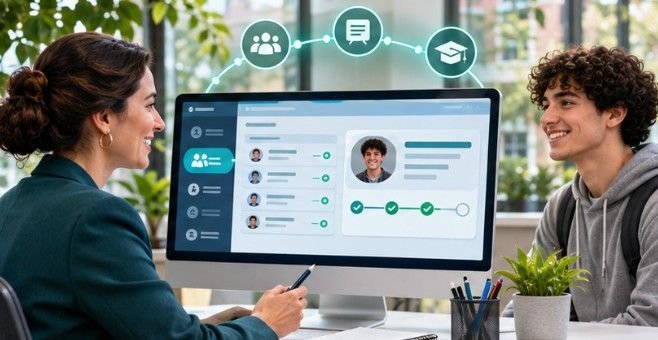
A student can receive an acceptance letter, submit an enrollment deposit, and still appear as an unfamiliar applicant when contacting the registrar. The problem often isn’t missing information. It’s disconnected institutional software.
Understanding how to integrate admissions CRM with student information system platforms helps colleges eliminate these gaps, reduce duplicate records, and move students smoothly from recruitment to registration.
The solution involves more than connecting two databases. Institutions must establish data ownership, automate enrollment updates, protect sensitive records, and verify that information remains consistent across departments.
Establish Which Platform Controls Each Record
One of the biggest integration mistakes is allowing both systems to modify the same information independently. Institutions need a documented system-of-record policy that determines where authoritative information originates.
Information the Admissions CRM Should Manage
The CRM generally maintains prospective student inquiries to automate school IT help desk ticket routing, recruitment interactions, marketing preferences, application activity, and admissions communications.
Admissions decisions may originate in the CRM, although institutional approval workflows can involve other systems. For example, an applicant’s preferred academic program might change during recruitment. The CRM can manage that update until the institution establishes the student’s official academic record.
Information the SIS Should Manage
After matriculation, the SIS typically becomes authoritative for official student identifiers, registration, grades, transcripts, and academic standing.
Financial aid information requires additional controls because specialized financial aid platforms may own particular records.
The two platforms can exchange selected information without granting unrestricted editing permissions. This prevents conflicting changes from repeatedly overwriting accurate data.
How to Integrate Admissions CRM With Student Information System: A Practical Process
A reliable integration follows a controlled sequence. Each stage should have an assigned owner, documented requirements, and measurable acceptance criteria.
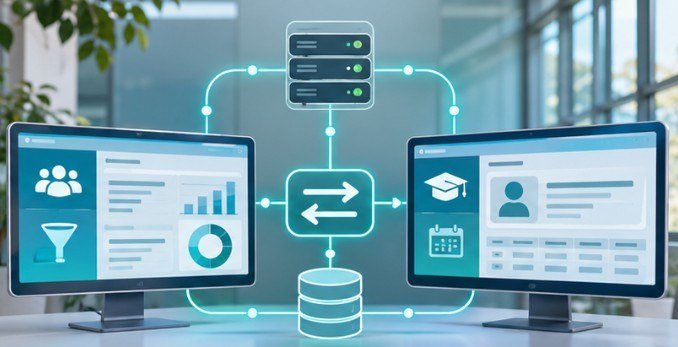
Step 1: Audit Existing Records and Enrollment Workflows
Begin by identifying how information currently moves between admissions, enrollment services, financial aid, and the registrar.
Document where employees export spreadsheets, manually enter information, or correct inconsistent records.
Pay particular attention to applicants who submit multiple applications, transfer students, and returning students. These groups frequently require more complex identity matching than first-time applicants.
Step 2: Create a Field-Mapping Document
Field mapping specifies how information in one platform corresponds to information in another. For example, a CRM field called Applicant_ID might connect to an SIS admissions reference, while Preferred_Name maps to a separate preferred-name field.
Other important mappings include application status, academic program, enrollment term, date of birth, contact information, and residency classification.
Standardize date formats, program codes, null values, and field lengths.
Never assume similarly named fields contain equivalent information. An admission date and an enrollment-effective date may represent different institutional events.
Step 3: Define the Student Record Transfer
A common workflow begins when an applicant satisfies the institution’s enrollment handoff requirements. The CRM then sends approved identity and admissions information to the SIS.
The SIS validates the information, checks for existing records, and creates or updates the appropriate student profile. After processing, it returns the institutional student ID and relevant enrollment status to the CRM.
This return process connects recruitment history with the official academic identity. Importantly, admission alone should not automatically create an enrolled-student designation.
Step 4: Select the Right Integration Architecture
Institutions generally choose among three approaches.
Native connectors are useful when vendors provide supported integrations compatible with the institution’s specific software versions and data models.
API integrations allow authorized systems to exchange information through defined interfaces. They offer flexibility for event-driven updates but require development, monitoring, and maintenance.
Middleware platforms such as Boomi or MuleSoft can coordinate transformations, routing, and error handling across several institutional applications.
Evaluate licensing, implementation effort, security capabilities, vendor support, and long-term maintenance before choosing.
Should Universities Use Real-Time or Batch Synchronization?

Not every enrollment-related update requires immediate processing. Real-time synchronization is valuable when students must proceed directly from acceptance to course registration or another time-sensitive service.
Scheduled synchronization can work well for routine reporting, historical record updates, and information that does not require immediate action.
A community college supporting rapid enrollment might prioritize event-driven updates. A university processing routine recruitment analytics could use nightly synchronization. Many institutions benefit from a hybrid approach.
The 1EdTech Consortium develops educational interoperability standards, including OneRoster for roster-related exchanges.
However, OneRoster primarily addresses SIS connections with learning applications. It should not be mistaken for a complete admissions CRM integration standard.
Protect Student Information Before Activating Data Sharing
Integration introduces additional routes through which sensitive information can travel.
The Family Educational Rights and Privacy Act (FERPA) governs protected education records at covered American institutions.
The U.S. Department of Education’s FERPA guidance explains that access to education records must follow applicable disclosure requirements.
Applicant records are not automatically FERPA-protected education records merely because someone applies. However, transcripts received from previous institutions can carry additional restrictions.
Institutions should implement role-based permissions, encrypted connections, secure credential management, and appropriate audit logging.
The National Institute of Standards and Technology’s API security guidelines also recommend evaluating vulnerabilities throughout the API lifecycle.
Sensitive financial aid information deserves particular scrutiny. Connecting systems does not automatically authorize using FAFSA data for recruitment or marketing.
Test the Integration Before Campus-Wide Deployment
A successful connection does not guarantee accurate information. Test environments should use synthetic or appropriately de-identified applicant records to simulate realistic enrollment scenarios.
Validate whether the integration correctly handles duplicate applications, missing birthdates, changed academic programs, withdrawn applicants, and returning students. A particularly important test involves sending the same enrollment event twice.
The integration should recognize the existing transaction rather than create another student profile.
This property, called idempotency, helps protect institutional data during retries and unexpected interruptions.
Monitor Failures and Measure Performance
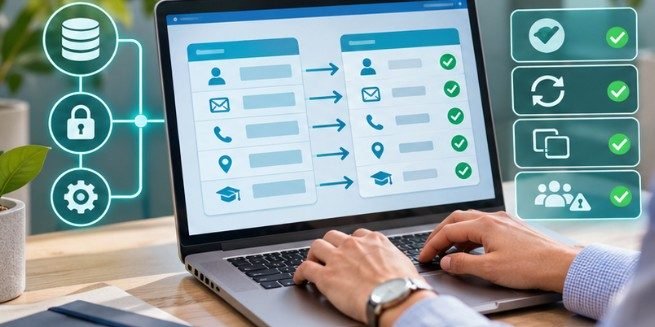
Integration teams should monitor processing failures, rejected records, synchronization delays, and unresolved identity matches.
For example, if 980 of 1,000 eligible records synchronize successfully, the processing success rate is 98%. That figure alone is insufficient. Teams must also determine whether the remaining 20 records affect registration or other essential services. Create alerts, retry procedures, exception queues, and clear escalation responsibilities.
Common Integration Mistakes That Create Expensive Rework
Some institutions prioritize moving information quickly without defining how records should be corrected later.
Others rely on email addresses as permanent identifiers, despite applicants changing addresses or using multiple accounts.
Another mistake is enabling unrestricted two-way synchronization. This can create endless update loops when conflicting values move between systems.
The EDUCAUSE integration governance guidance recommends structured approval processes involving appropriate technology, security, and institutional stakeholders.
A better approach is to establish field ownership, use persistent identifiers, document exception handling, and review integration permissions regularly.
Frequently Asked Questions
1. Can an admissions CRM integrate with any SIS?
Not necessarily. Compatibility depends on supported APIs, vendor connectors, data formats, licensing, and institutional customization. Older platforms may require middleware or controlled file transfers.
2. How long does CRM and SIS integration take?
Timelines vary considerably. Simple supported integrations may require weeks, while complex projects involving legacy systems, extensive data cleanup, and custom workflows can take months.
3. Is two-way synchronization always necessary?
No. Some institutions only need selected SIS updates in the CRM. Bidirectional synchronization should be limited to clearly defined business requirements and authoritative fields.
4. How can institutions reduce duplicate student records?
Use persistent identifiers, identity-matching rules, duplicate-detection checks, and human review for uncertain matches. Never rely exclusively on student names or email addresses.
Building a More Reliable Student Enrollment Experience
The most important outcome of CRM–SIS integration isn’t faster data transfer. It’s ensuring students receive consistent service as they move between institutional departments.
A carefully designed connection allows admissions teams to maintain meaningful relationships while registrars and academic departments work with trustworthy records.
Start by documenting data ownership, mapping essential fields, and testing one enrollment workflow before expanding automation.
Treat security, exception monitoring, and ongoing governance as permanent responsibilities rather than final implementation tasks.
When institutional systems share accurate information without competing for control, enrollment becomes easier for employees and far less frustrating for students.



2 thoughts on “How to Integrate Admissions CRM With Student Information System Without Data Errors”