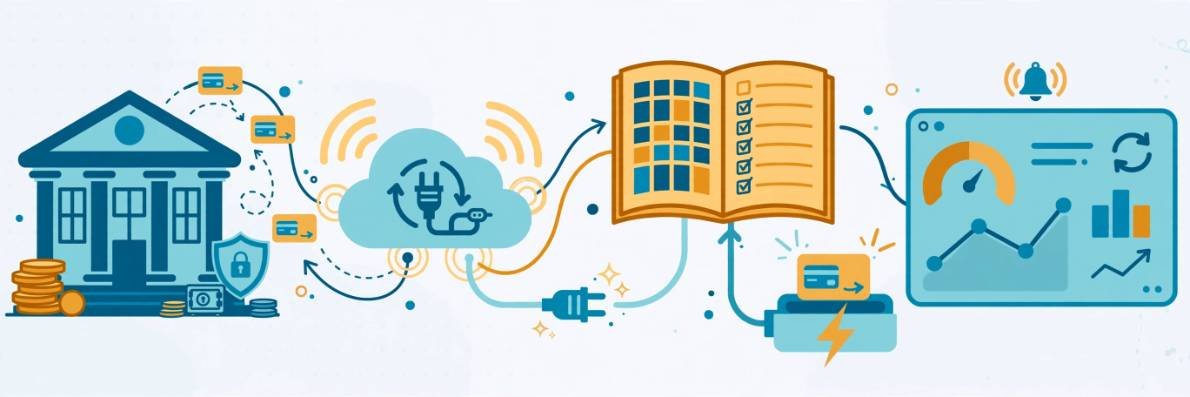

Three years ago, I watched a five-person accounting team spend eleven straight nights reconciling 14,000 SaaS subscriptions in Excel because a mid-quarter pricing change broke their CSV exports. Building an automated revenue recognition api integration fixed that bottleneck permanently by connecting our billing platform, CRM, and ERP to record earned revenue in real time.
Instead of waiting until the fifth business day of the month to calculate deferrals, modern finance teams stream transaction events straight into a sub-ledger. When configured properly, your API pipeline enforces compliance with FASB ASC 606 and IFRS 15 rules automatically.
Why Manual Month-End Close Breaks at Scale
Spreadsheets survive when you have fifty annual contracts with identical renewal dates. They collapse the moment your sales team introduces usage tiers, mid-cycle seat upgrades, or multi-element bundles.
Every manual CSV upload introduces human latency and version-control risk. When I audited our legacy workflow, nearly 18% of deferred revenue adjustments stemmed from mismatched start dates between Salesforce and our billing database. Many RevOps teams try to automate month-end close with ipaas connectors early on, which helps move raw invoices. However, simple data piping fails if your integration lacks accounting logic to split contracts into distinct performance obligations.
Core Architecture of an ASC 606 and IFRS 15 Revenue API Pipeline
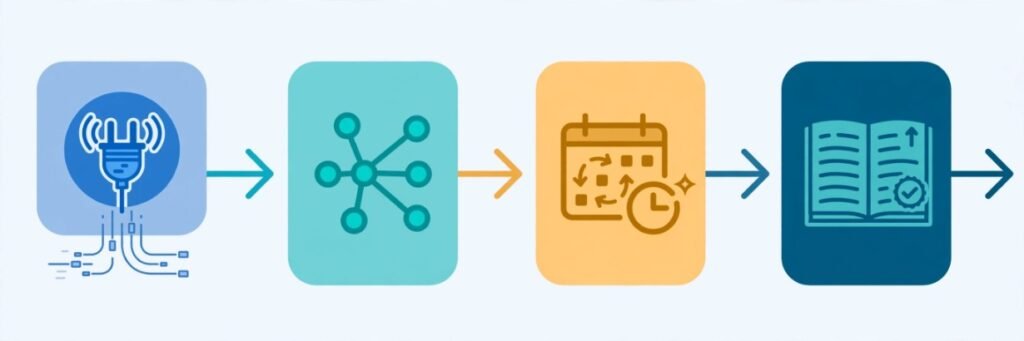
When I re-architected our revenue stack, I separated data transport from accounting rule execution. A resilient automated revenue recognition api integration runs through four sequential stages.
1. Event Ingestion and Webhook Triggers
Upstream systems emit JSON payloads whenever a financially material event happens. Rather than polling databases once a night, I configure real-time webhooks for four triggers:
- Contract execution: A signed order form in your CRM or a self-serve checkout completion.
- Provisioning: Product activation or API key generation, which often marks the true start of service delivery.
- Billing and payment: Invoice finalization, cleared ACH transfers, or credit card settlements.
- Usage metering: Hourly or daily consumption logs for token-based or metered billing models.
2. Performance Obligation and SSP Mapping
Once ingested, the recognition engine parses line items against your Standalone Selling Price (SSP) catalog. Under the five-step ASC 606 framework, bundled items—such as a 12-month software license paired with a one-time onboarding package—must be separated if they deliver distinct value. My integration maps each incoming SKU ID to a pre-approved accounting rule before generating a single schedule entry.
3. Dynamic Schedule Generation and Mid-Cycle Modifications
The engine allocates transaction prices across distinct obligations and builds daily or monthly amortization waterfalls. Point-in-time items, like hardware shipments or completed setup milestones, recognize immediately upon delivery. Over-time subscriptions amortize ratably across the service window. When a customer upgrades mid-month, the API recalculates remaining unamortized balances prospectively without manual overrides.
4. Automated General Ledger (GL) Posting
Finally, the sub-ledger aggregates daily recognition events into balanced debit and credit journal entries. Instead of flooding your ERP with millions of micro-transactions, the integration pushes summarized journal batches via REST API. Every summary line retains a drill-down ID linking back to the source invoice.
Worked Example: Tracing a Mid-Cycle SaaS Upgrade Through the API

To see how this operates in production, consider a customer who buys a $12,000 annual platform subscription starting January 1, plus a $2,000 one-time onboarding fee.
- Day 1 (Contract Signed & Provisioned): The webhook fires contract.activated. The API splits the $14,000 total into two obligations. Onboarding ($2,000) recognizes immediately upon completion. The platform subscription ($12,000) creates a 12-month schedule releasing $1,000 per month from Deferred Revenue (Liability) to Earned Revenue.
- April 1 (Mid-Cycle Upgrade): The customer adds seats worth $4,500 for the remaining nine months. Your billing system sends an invoice.finalized payload referencing the original contract_id.
- API Recalculation: Instead of creating a disconnected orphan schedule, the recognition engine appends the $4,500 modification to the existing obligation. It adds 500permonth(4,500 ÷ 9 months) to the existing $1,000 monthly run rate, smoothly adjusting April through December recognition to $1,500 per month.
Without unified contract IDs passed through your middleware, your ERP treats that $4,500 upgrade as a separate standalone contract—distorting ARR cohorts and triggering audit flags.
Comparing Top Revenue Recognition API Platforms
Choosing the right platform depends on whether your bottleneck is payment reporting, high-volume usage metering, or native ERP consolidation.
| Platform | Primary Focus | Key API & Integration Capabilities |
| Stripe Revenue Recognition | Payment & Subscription Reporting | Generates programmatic CSV accrual reports via /v1/reporting/report_runs broken down by customer, invoice, or line item. |
| RightRev | Complex & Hybrid Billing | Offers an ERP-agnostic Open API supporting event-based triggers, automated contract modifications, and direct GL posting. |
| BillingPlatform | Usage & AI Monetization | Meters API calls, tokens, and outcomes on a single metadata model flowing straight into ASC 606 journal entries. |
| Salesforce Revenue Cloud | Quote-to-Cash Sync | Connects CRM orders and contracts directly to downstream accounting systems via an API-first architecture. |
| NetSuite ARM | Native ERP Accounting | Automates revenue-element creation and allocation directly inside the core ledger via the RevRecSchedule REST record. |
If your billing lives entirely inside Stripe, the Stripe Revenue Recognition API provides fast programmatic accrual exports. However, once you introduce custom enterprise order forms or multi-entity ERP requirements, dedicated sub-ledgers or native tools like Oracle NetSuite Revenue Recognition prevent data silos. When teams automate month-end close with ipaas workflows alongside these APIs, close times routinely drop from ten days to under forty-eight hours.
Production Pitfalls I Learned the Hard Way

Even well-documented APIs fail when real-world network conditions hit. Build these four safeguards into your integration before going live:
- Enforce strict idempotency keys: Webhook providers retry failed deliveries automatically. Always pass a unique idempotency_key (such as invoice_id + event_timestamp) so network retries never double-book earned revenue.
- Validate upstream metadata at the gate: Reject or quarantine payloads missing service_start_date, service_end_date, or currency_code before they hit your sub-ledger. Fixing dirty dates in an ERP is ten times harder than blocking bad JSON at the webhook listener.
- Build dead-letter queues and Slack alerts: Silent API failures ruin close week. Route HTTP 400/500 errors or unmapped SKU exceptions to a dead-letter queue with instant alerts to your accounting operations channel.
- Preserve immutable audit lineage: Store the upstream charge_id, invoice_id, and contract_id inside the memo or custom fields of every posted GL journal entry. External auditors will ask you to trace summary ledger balances back to individual bank deposits.
Frequently Asked Questions
1. What is an automated revenue recognition API integration?
It is a real-time software connection between billing, CRM, and ERP systems that automates ASC 606 and IFRS 15 calculations and posts journal entries directly to your general ledger.
2. How does a revenue recognition API handle contract modifications?
The API links amendment payloads to the original contract ID, automatically recalculating remaining deferred balances and reallocating schedules across updated service periods.
3. Can I use Stripe Revenue Recognition API with NetSuite?
Yes, you can programmatically fetch accrual report runs from Stripe’s reporting endpoints and push summarized debit and credit entries into NetSuite via REST API or middleware.
4. Why are idempotency keys critical in revenue recognition integrations?
Idempotency keys prevent duplicate webhook retries from generating duplicate amortization schedules and overstating revenue on your general ledger.
Stop Reconciling Revenue by Hand at Midnight
Your accounting team was hired to analyze margins and guide strategy, not babysit VLOOKUP formulas at 11 PM on a Friday. Start by auditing one single workflow: trace how a mid-cycle upgrade moves from your CRM to your general ledger today.
Once you standardize your upstream contract IDs and enforce webhook idempotency, your automated revenue recognition api integration will turn month-end close from a fire drill into a non-event.