

Multi-currency accounting reconciliation automation replaces fragile month-end currency spreadsheets with software that matches individual transactions in both their original local currency and your base reporting currency. When I first managed month-end close across three international subsidiaries, our team spent four full days chasing phantom $400 variances that turned out to be a mix of correspondent bank fees and stale exchange rates.
Switching to automated transaction-level matching cut our close time in half and eliminated unexplained foreign exchange (FX) write-offs before our external auditors ever arrived.
If you reconcile cross-border payouts by comparing converted summary totals at month-end, your general ledger is hiding operational leaks.
Why Manual Multi-Currency Reconciliation Breaks at Scale
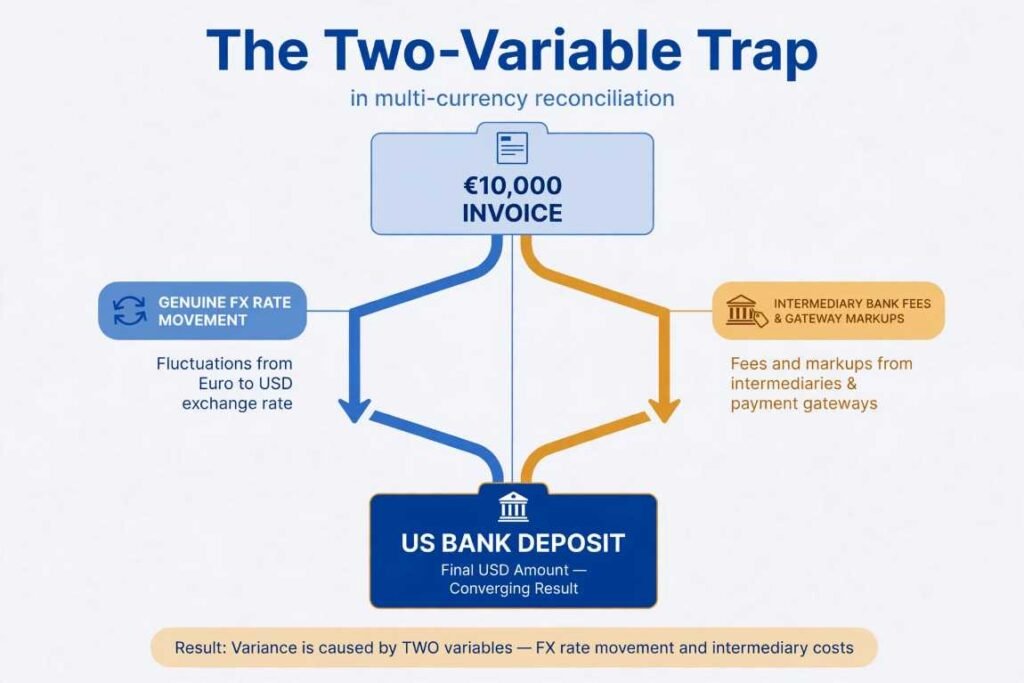
A domestic bank reconciliation checks one variable: did the cash amount in the bank match the invoice in the ledger? Cross-border transactions introduce a second variable—the exchange rate—alongside settlement delays and multi-hop banking fees.
The Two-Variable Trap: Rate Drift vs. Intermediary Fees
When a European customer pays a €10,000 invoice and $10,780 lands in your US operating account three days later, a manual spreadsheet usually dumps the entire variance into a generic “FX Gain/Loss” account. That shortcut distorts your gross margins.
In my experience auditing payment processor payouts, up to 30% of what teams book as “currency loss” is actually unrecorded SWIFT transfer fees, payment gateway FX markups, or minor rounding gaps.
Automated reconciliation engines solve this by validating the local currency amount independently from the applied spot rate. They isolate the exact wire fee into a bank charges expense account while booking only genuine market movement to FX gain or loss.
Realized Gains vs. Unrealized Period-End Revaluations
Under FASB ASC 830 (US GAAP) and IFRS IAS 21, finance teams must strictly separate settled transactions from open balances at month-end:
- Realized FX Gain/Loss: Occurs when cash actually changes hands. If you issue an invoice at 1.08 USD/EUR and collect cash when the rate hits 1.10 USD/EUR, that gain is permanently locked in.
- Unrealized FX Gain/Loss: Occurs when an invoice, bill, or foreign bank account remains open on the balance sheet date. Automation tools revalue open monetary items at the closing spot rate and automatically post reversing entries on day one of the following period.
Worked Example: Automating an EUR-to-USD Settlement and Revaluation
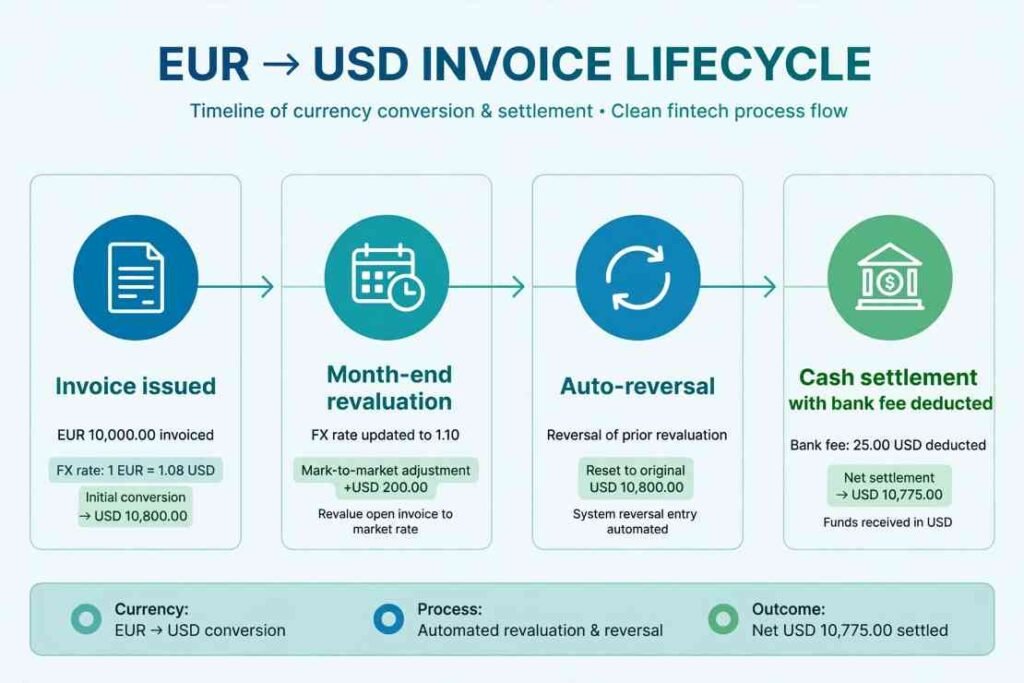
To see how an automated engine protects ledger accuracy, look at how a single €50,000 customer invoice flows through a US dollar functional ledger across two accounting periods:
- Invoice Issued (October 15): You bill a German client €50,000 when the daily spot rate is 1.0800 USD/EUR. The system records Accounts Receivable of $54,000.00.
- Month-End Revaluation (October 31): The invoice remains unpaid at period-end, and the closing spot rate rises to 1.0950 USD/EUR. The software automatically revalues the open receivable to $54,750.00, crediting $750.00 to Unrealized FX Gain.
- Auto-Reversal (November 1): On the first day of the new month, the system reverses the $750.00 unrealized entry so your ledger does not double-count currency movement.
- Cash Settlement (November 12): The client pays €50,000 when the spot rate is 1.0900 USD/EUR ($54,500.00 gross), minus a $25.00 intermediary bank wire fee, depositing $54,475.00 into your bank.
An automated reconciliation rule matches the deposit back to the original €50,000 invoice, books $25.00 to Bank Service Charges, and posts exactly $500.00 to Realized FX Gain ($54,500.00 settlement value minus $54,000.00 original invoice value). Doing that manually across 2,000 monthly transactions invites guaranteed spreadsheet fatigue.
Comparing Multi-Currency Reconciliation Software Architectures
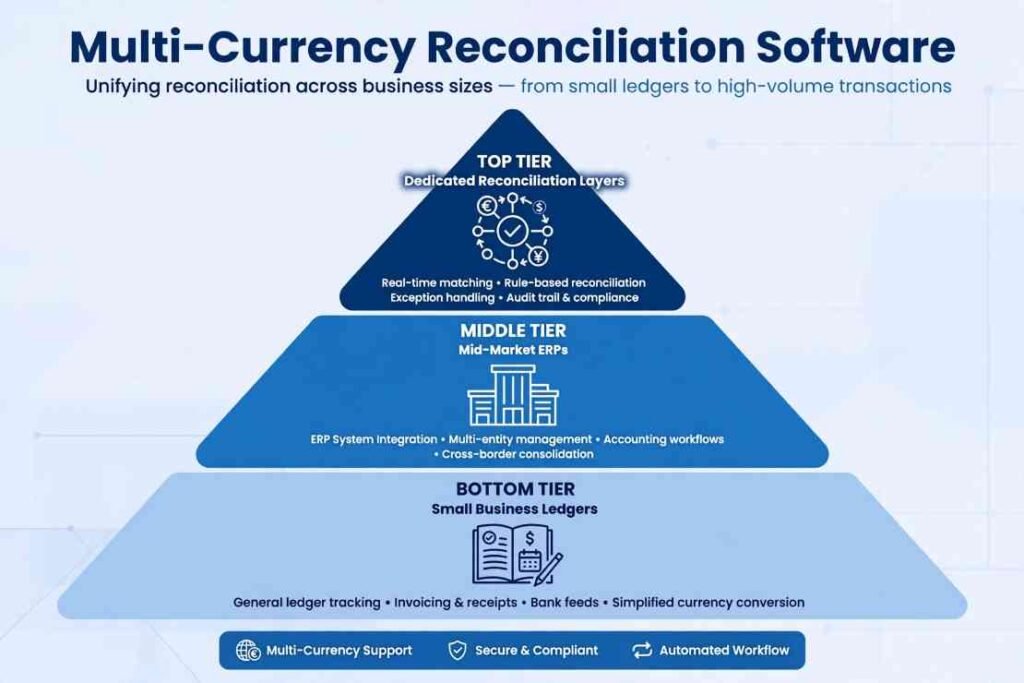
Not every company needs a heavyweight enterprise platform. Over the past five years, I have implemented all three tiers of multi-currency tooling depending on transaction volume and entity count.
| Software Tier | Representative Tools | Best Operational Fit | Primary Architectural Limitation |
| Small Business Ledgers | Xero, QuickBooks Online, Zoho Books | Single entities billing or paying overseas in under five currencies. | Handles basic invoice conversion, but leaves multi-entity eliminations and Cumulative Translation Adjustments (CTA) to manual spreadsheets. |
| Mid-Market & Enterprise ERPs | NetSuite, Sage Intacct, Odoo | Multi-subsidiary groups operating across different functional currencies. | Automates ASC 830 revaluations and consolidation natively, though high-volume payment gateway settlements can still clog the general ledger. |
| Dedicated Reconciliation Layers | Simetrik, Kosh AI, AutoRek, Finlens | High-volume e-commerce, SaaS, and fintech companies using multiple payment processors. | Sits above the ERP. Cleanses millions of micro-transactions, FX spreads, and gateway fees before posting summarized journal entries. |
Small Business Accounting Ledgers
Entry-level cloud ledgers automatically pull daily exchange rates and calculate realized gains when you match a payment to an open bill. They work well until you add a foreign subsidiary. Once you need to translate a UK entity’s GBP trial balance into a US parent’s USD consolidated report, basic ledgers hit a wall.
Mid-Market and Enterprise ERPs
Platforms like NetSuite and Sage Intacct excel at structural consolidation. They distinguish between a subsidiary’s functional currency and the parent’s reporting currency, routing translation differences straight to Accumulated Other Comprehensive Income (AOCI) rather than distorting operating net income. Connecting your upstream billing engine via a clean quote-to-cash integration architecture ensures every invoice carries its original currency metadata directly into the ERP.
Dedicated Transaction Reconciliation Layers
When a SaaS business processes 50,000 Stripe, Adyen, and PayPal payouts across 18 currencies, pushing every raw line item into an ERP slows down reporting. A dedicated reconciliation layer ingests raw settlement files, matches them against your bank feed api integration for ERP, isolates processor FX markups, and posts one clean daily summary journal entry.
Four Governance Rules I Configure Before Turning on Automation
Software only executes the accounting policy you give it. Before activating automated matching rules in any new environment, I lock down four parameters:
- Authoritative Rate Feeds: Standardize on one daily feed—such as OANDA, XE, or official central bank benchmarks like the Federal Reserve Board H.10 release—and document that choice for your auditors. For annual tax translations, verify alignment with IRS yearly average currency exchange rates.
- Penny and Basis-Point Tolerances: Set auto-clear rules for trivial rounding variances (for example, anything under $2.00 or 0.05% of the transaction value) so your team only investigates true exceptions.
- Strict Chart-of-Accounts Mapping: Route realized FX gains/losses, unrealized revaluation adjustments, and processor FX fees into three separate GL accounts. Never let software bundle bank fees into FX variance.
- Source Currency Discipline: Require every upstream billing tool, expense card, and bank export to pass both the original transaction currency and the settled currency. Without both fields, automated two-way matching cannot verify the underlying conversion rate.
Frequently Asked Questions
1. What is the difference between multi-currency invoicing and multi-currency reconciliation?
Multi-currency invoicing simply displays a price and collects payment in a buyer’s local currency, whereas multi-currency reconciliation matches that settlement against your ledger, isolates bank fees, and calculates realized or unrealized FX gains and losses.
2. How does automation handle unrealized FX gains and losses at month-end?
The software automatically revalues open foreign-currency receivables, payables, and cash accounts using the period-end closing spot rate, posts the unrealized gain or loss to the income statement, and reverses the entry on the first day of the next period.
3. Can small businesses automate multi-currency reconciliation without buying an ERP?
Yes, cloud ledgers like Xero and QuickBooks Online include built-in exchange rate feeds and automated realized FX calculations that easily handle single-entity businesses operating in a handful of foreign currencies.
4. Why do bank deposits rarely match the exact converted invoice amount?
Deposits differ from original invoice conversions because exchange rates shift between the invoice date and settlement date, and intermediary banks or payment processors deduct wire fees and FX spreads before funds reach your account.
Ditch the Franken-Spreadsheet Before Your Next Audit
If your finance team still exports CSV files from three payment gateways and VLOOKUPs monthly average exchange rates on day five of close, you are spending senior accounting hours on clerical detective work.
Audit your last month-end close to see how much time went into chasing unexplained currency variances. Once you separate processor fees from true rate movement and automate transaction-level matching, month-end close shifts from manual cleanup to strategic cash-flow analysis.



One thought on “Multi-Currency Accounting Reconciliation Automation: How I Eliminated Month-End FX Variances”