
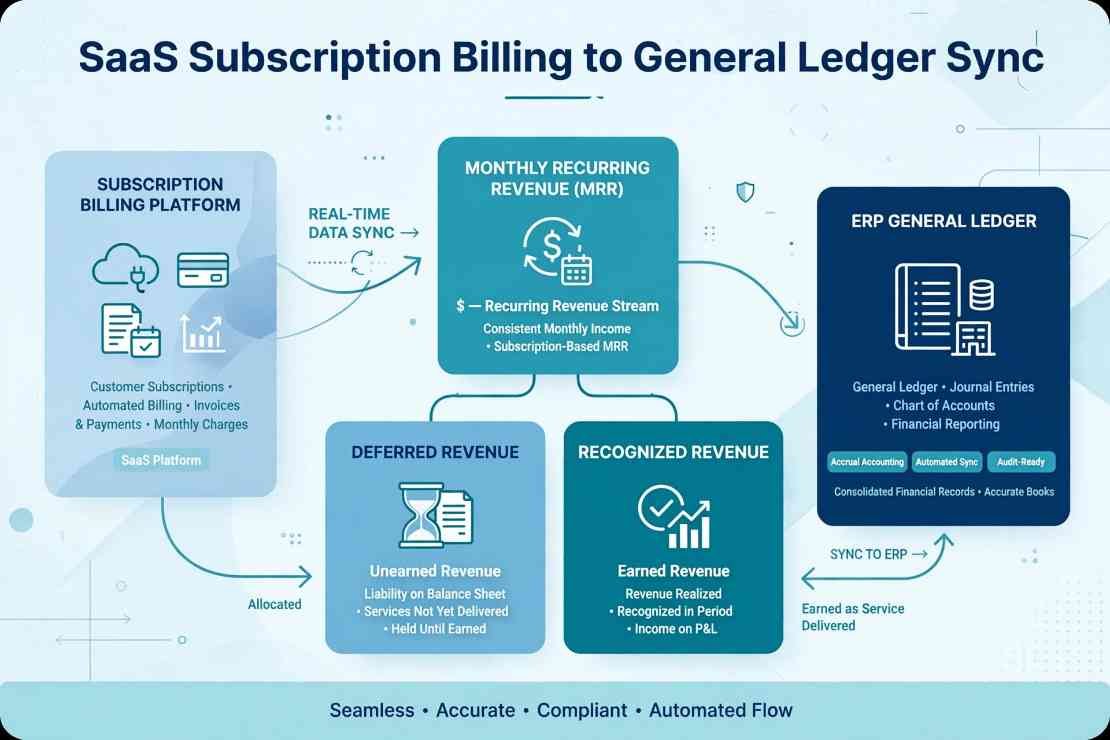
Setting up a clean saas subscription billing to general ledger sync is the single fastest way to cut a 12-day month-end close down to 48 hours. When I led the finance systems overhaul at a fast-growing B2B software company, our biggest bottleneck was manually translating Stripe invoices into NetSuite journal entries.
Operational billing tools track what customers owe right now. Your General Ledger (GL) tracks when your business actually earns that money under accrual accounting rules. Bridging those two systems without manual spreadsheets requires strict mapping rules, automated schedules, and clean architectural boundaries.
Why Cash Accounting Breaks Down in Subscription Models
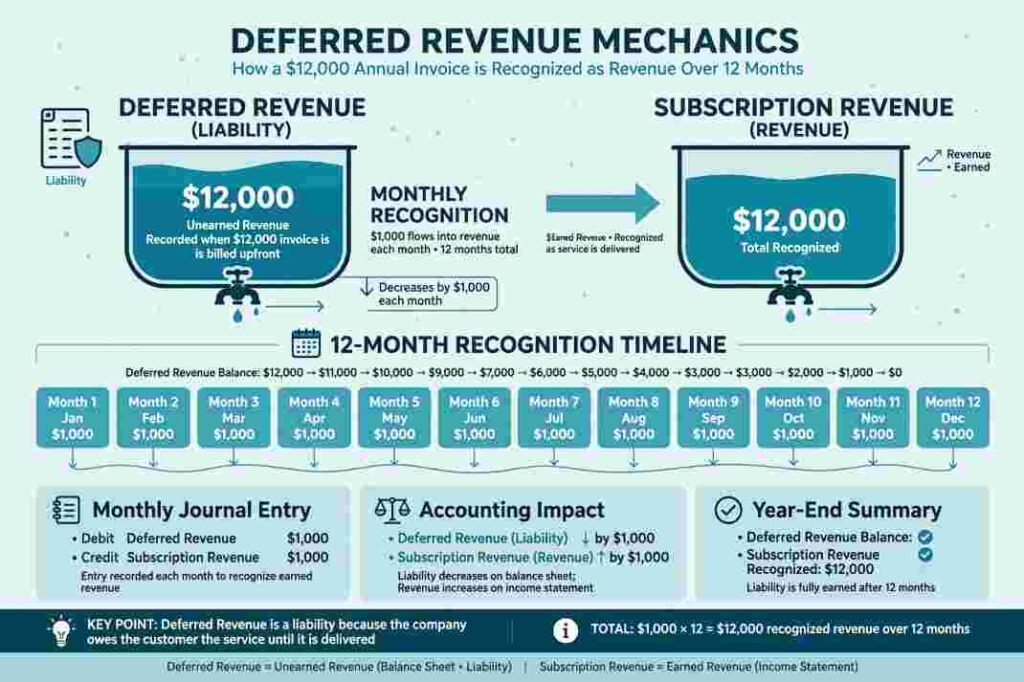
If a customer pays $12,000 upfront for a 12-month software license, you cannot book $12,000 in immediate revenue on day one. Under the FASB ASC 606 standard and the international IFRS 15 framework, revenue is recognized only as you satisfy your performance obligation over time.
When billing platforms push raw cash receipts straight into revenue accounts, your income statement becomes wildly distorted. High renewal months look artificially profitable, while quiet months look like a downturn. Your billing-to-GL integration exists to translate operational events—like new signups, upgrades, refunds, and renewals—into compliant accrual entries.
Core Accounting Mechanics Behind Every Sync
Before writing a single webhook or configuring an ERP connector, you must map five distinct financial events to specific chart-of-accounts codes.
Invoice Issuance and Deferred Revenue Liabilities
When your billing engine generates an annual invoice, your sync must debit Accounts Receivable and credit Deferred Revenue. Deferred Revenue sits on your balance sheet as a liability because you still owe the customer twelve months of software access. No revenue hits your profit and loss statement at this stage.
Automated Revenue Recognition Schedules
As each service period passes, your integration systematically drains that liability. On a monthly schedule, the system debits Deferred Revenue and credits Subscription Revenue in equal increments. For enterprise contracts with daily precision rules, modern billing engines calculate exact day counts per month so 28-day February schedules differ slightly from 31-day March schedules.
Prorations, Gateway Fees, and Sales Tax Routing
Mid-cycle changes create immediate accounting friction if left unmapped. When a customer upgrades mid-month, your billing platform issues prorated credits for the old tier and charges for the new tier. Your sync must dynamically recalculate the remaining deferred revenue schedule so future months reflect the updated run rate.
Settlements require equal precision. When an automated payment gateway like Stripe or Adyen deposits funds into your bank account, it deducts processing fees before payout. Your sync needs to debit Cash for the net deposit, debit Merchant Processing Fees for the gateway cut, and credit Accounts Receivable for the gross invoice amount.
Finally, never blend taxes or discounts into gross revenue. Sales tax and VAT belong strictly in a Sales Tax Payable liability account. Discounts should route to a dedicated contra-revenue account so your finance team retains clear visibility into gross margins and discounting behavior.
Worked Example: Tracking an Annual Contract With a Mid-Year Upgrade
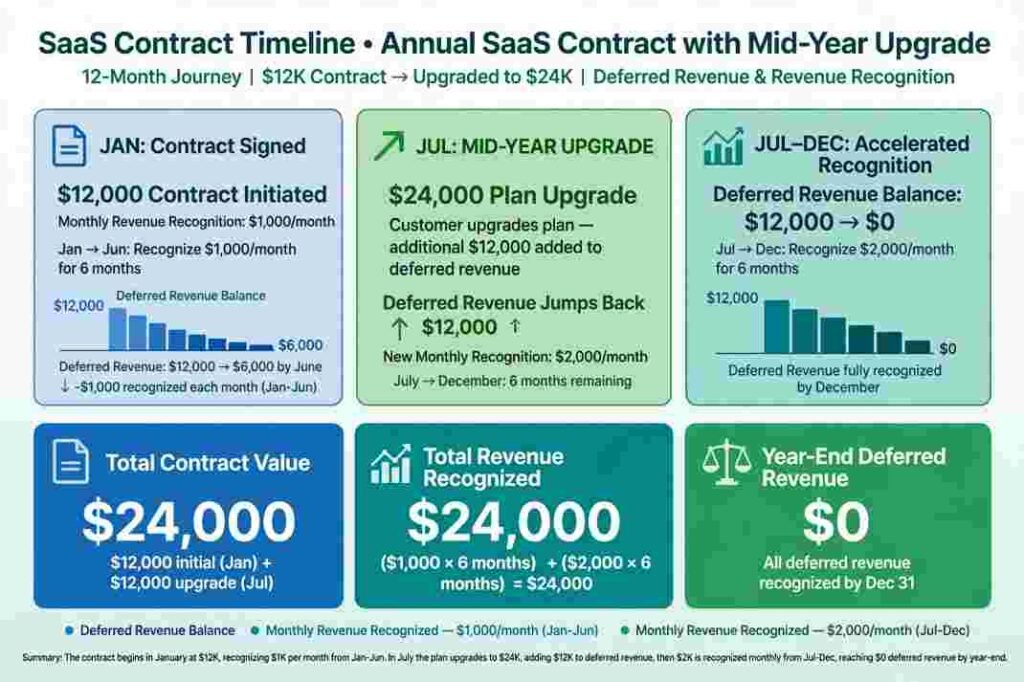
Abstract rules become much clearer with real numbers. Here is the exact journal sequence I use to test every new saas subscription billing to general ledger sync before pushing it to production.
Suppose a customer signs a $12,000 annual contract on January 1, paid immediately via credit card with a 2.9% processing fee ($348).
| Date | Event | GL Account | Debit | Credit |
| Jan 1 | Invoice Issued | Accounts Receivable | $12,000 | — |
| Jan 1 | Invoice Issued | Deferred Revenue | — | $12,000 |
| Jan 3 | Payment Settled | Operating Cash | $11,652 | — |
| Jan 3 | Payment Settled | Merchant Processing Fees | $348 | — |
| Jan 3 | Payment Settled | Accounts Receivable | — | $12,000 |
| Jan 31 | Month 1 Rev-Rec | Deferred Revenue | $1,000 | — |
| Jan 31 | Month 1 Rev-Rec | Subscription Revenue | — | $1,000 |
From January through June, you recognize $1,000 per month. By June 30, you have recognized $6,000 in revenue, leaving $6,000 in Deferred Revenue.
On July 1, the customer upgrades to a $24,000 annual plan. The billing system applies the unused $6,000 credit against the new $12,000 six-month cost, invoicing the customer for $6,000. Your sync debits Accounts Receivable for $6,000 and credits Deferred Revenue for $6,000, bringing the liability balance back to $12,000. From July through December, your monthly recognition schedule automatically shifts to $2,000 per month.
Three Architectures for Your Billing-to-ERP Integration
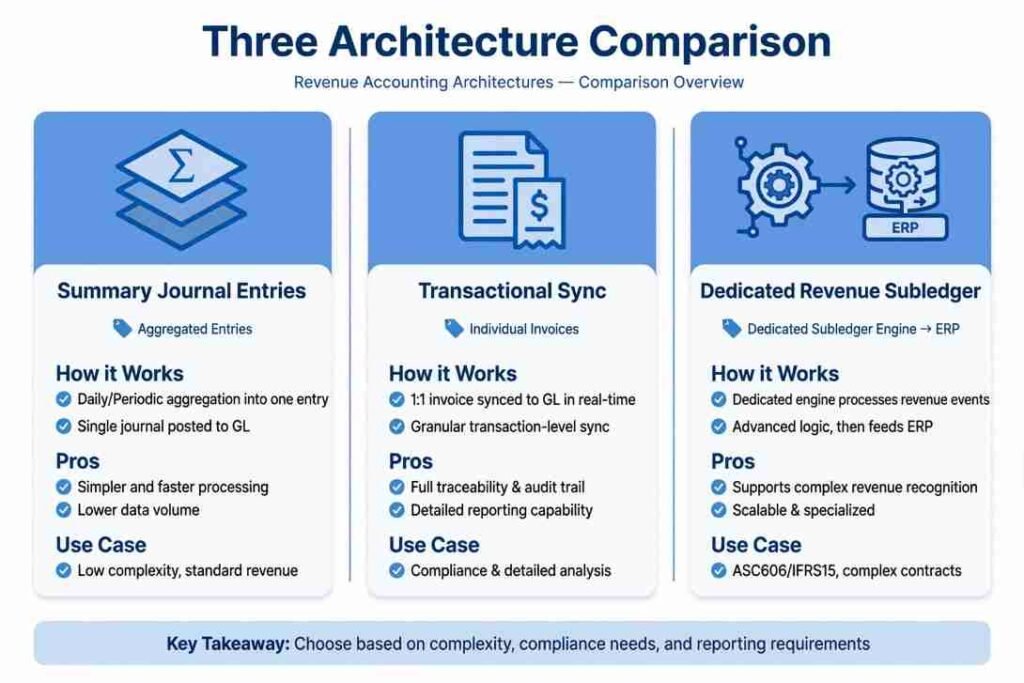
Choosing the right sync architecture depends entirely on your invoice volume, contract complexity, and audit readiness.
Summary Journal Entries
Summary syncing aggregates daily or monthly billing activity by account code and posts one summarized journal entry into your ERP. I recommend this setup for high-volume B2C or product-led growth companies processing tens of thousands of $19 monthly subscriptions. It keeps cloud accounting platforms like QuickBooks or Xero fast and uncluttered. The main trade-off is granularity: if an auditor asks about one specific customer, you must pull that record from your billing subledger rather than your ERP.
Transactional Sync
Transactional syncing pushes every individual invoice, payment, and credit memo directly into your ERP as a standalone record. B2B enterprise companies with fewer than 500 high-value contracts and custom payment terms benefit most from this approach. It gives controllers complete customer-level audit trails inside the ERP, though high transaction volumes will quickly hit API rate limits.
Dedicated Revenue Subledger Architecture
Once a SaaS company prepares for Series B fundraising, institutional audits, or an IPO, native ERP modules often struggle with complex contract modifications. A subledger architecture keeps all granular billing data and ASC 606 schedules inside a dedicated engine like Chargebee, Maxio, or Stripe Revenue Recognition. The subledger handles daily proration math and pushes clean, summarized roll-up entries into NetSuite or Sage Intacct.
Four Sync Pitfalls I Learned to Fix the Hard Way
Even well-architected integrations break when edge cases hit production. Watch out for these four failure points:
- Syncing Draft or Voided Invoices: During my first ERP rollout, a misconfigured webhook synced draft invoices into NetSuite. It created $180,000 in phantom Accounts Receivable that took days to untangle. Configure your triggers to fire strictly on finalized, posted invoices.
- Multi-Currency Revaluation Mismatches: Billing European customers in EUR while reporting in USD introduces exchange rate drift between the invoice date and settlement date. Your multi-currency accounting workflow must route those differences to realized FX gain or loss accounts automatically, aligning with SEC revenue guidance.
- Hardcoding Product Names: Never map sync rules to specific SKU names in your integration middleware. Assign standardized GL account codes—such as 4010 – Core SaaS and 4020 – Onboarding Services—directly inside your billing catalog so new pricing tiers map automatically.
- Mishandling Dunning and Failed Payments: A declined credit card should trigger dunning workflows in your billing app, not clear Accounts Receivable in your GL. Define a clear accounting policy—typically at 90 or 120 days past due—for writing off uncollectible balances to Bad Debt Expense.
Frequently Asked Questions
1. What is a SaaS subscription billing to general ledger sync?
It is an automated data pipeline that translates operational billing events like invoices, payments, and upgrades into compliant accrual accounting journal entries inside your ERP.
2. Why can’t SaaS companies recognize annual subscription cash upfront?
Under ASC 606 and IFRS 15, revenue must be recognized ratably as software services are delivered over the contract term rather than when cash is collected.
3. Should SaaS startups use summary or transactional GL syncing?
High-volume, low-ACV startups should use summary journal entries to protect ERP performance, while low-volume B2B enterprise teams should use transactional syncing for customer-level audit trails.
4. How do mid-cycle subscription upgrades affect deferred revenue?
Mid-cycle upgrades generate prorated credits and new charges that increase the remaining deferred revenue balance, raising the monthly revenue recognition run rate for the rest of the term.
Stop Reconciling Spreadsheets at 2 AM
A reliable saas subscription billing to general ledger sync turns your finance team from backward-looking data cleaners into forward-looking strategic partners. Start by auditing your current chart of accounts today: map every active billing SKU to a single standardized GL code before touching a single integration setting. Once your catalog codes are clean, test your sync rules in a sandbox environment using a mid-year upgrade scenario before flipping the switch to live production.


2 thoughts on “SaaS Subscription Billing to General Ledger Sync: A Field Guide”