

A broken CRM to ERP quote-to-cash integration architecture does not just slow down sales operations—it creates duplicate invoices, oversold inventory, and month-end accounting nightmares. Early in my career leading enterprise revenue operations builds, a single unguarded webhook retry generated four identical $85,000 sales orders in NetSuite within twelve seconds. Fixing that mess taught me that moving data between sales and finance requires far more than simple field mapping.
You need an architecture built for network failures, strict data ownership, and real-time visibility. Below is the exact three-tier blueprint, data flow sequence, and fault-tolerance framework I use to connect front-office quoting engines with back-office financial systems.
Why Basic CRM-to-ERP Syncs Fail Under Real Sales Volume
Most teams start by connecting their CRM directly to their ERP using point-to-point webhooks. That approach works fine at ten orders a week. Once deal velocity climbs or reps start amending quotes mid-flight, point-to-point syncs collapse.
Without a middleware buffer, an ERP maintenance window blocks sales reps from generating quotes. Worse, if a network timeout drops an acknowledgment packet, the CRM assumes the order failed and fires the payload again. True quote-to-cash (Q2C) architecture decouples sales speed from accounting rigidity while guaranteeing every approved quote becomes exactly one valid sales order.
The Three Core Architectural Layers of Quote-to-Cash
A scalable Q2C integration separates responsibilities across three distinct tiers so neither system becomes a bottleneck.
Front-Office Layer (CRM and CPQ)
Your CRM and Configure, Price, Quote (CPQ) tools own customer relationships, opportunity stages, product bundling, and discounting rules. Based on Salesforce CPQ architectural best practices, the front office should focus strictly on commercial configuration rather than tax calculation or ledger posting. Sales reps stay inside one interface without waiting on finance approvals for standard deals.
Integration Middleware (iPaaS and Event Broker)
The middleware layer—such as MuleSoft, Workato, or an event broker like Apache Kafka—acts as the traffic controller. It handles API routing, payload transformation, schema validation, authentication, and retry queues. Following NIST API security guidelines, this layer also enforces OAuth 2.0 token rotation and mutual TLS so credentials never sit hardcoded inside CRM triggers.
Back-Office Layer (ERP and Billing)
Your ERP—whether SAP S/4HANA, NetSuite, or Dynamics 365—serves as the financial system of record. It controls physical inventory allocation, credit limits, fulfillment logistics, revenue recognition, and general ledger entries. Once payment arrives, pairing this layer with a reliable bank feed api integration for ERP closes the final loop between cash collection and open receivables.
End-to-End Q2C Data Flow Across Five Stages

To eliminate manual re-entry, data must move bidirectionally across five sequential checkpoints:
- Master Data Synchronization: The ERP pushes authoritative product catalogs, SKU hierarchies, pricing tiers, and live stock counts to the CRM. Reps quote accurate inventory without pinging warehouse managers.
- Account and Credit Validation: When an opportunity reaches a qualified stage, the CRM syncs customer details to the ERP. The ERP validates tax IDs, runs credit checks, and returns an approved billing account ID.
- Quote-to-Order Conversion: Marking a quote “Closed Won” triggers an event payload to the middleware, which transforms the quote lines into an ERP sales order.
- Fulfillment and Status Write-Back: As warehouse teams ship goods or provision SaaS licenses, the ERP pushes tracking numbers and fulfillment statuses back to the CRM opportunity record.
- Invoicing and Payment Reconciliation: The ERP generates the final invoice and tracks payment settlement. Updating invoice balances inside the CRM gives account managers clear visibility before renewal conversations begin, especially when paired with automated matching workflow automation on the finance side.
Choosing the Right Integration Pattern for Each Transaction
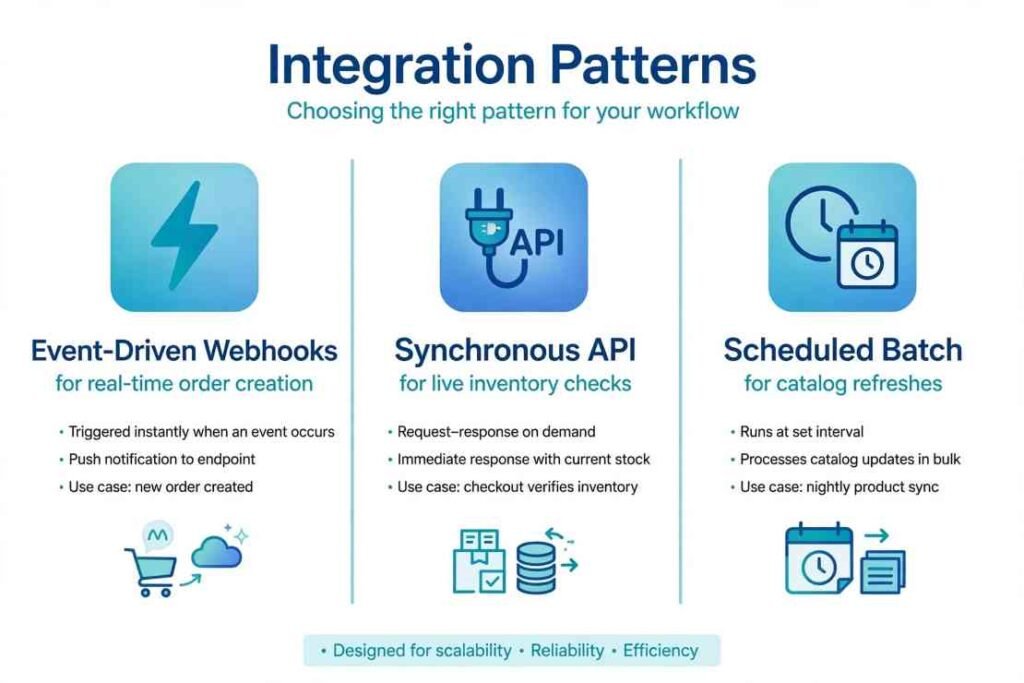
Forcing every Q2C interaction through a single communication protocol creates unnecessary latency. I match the integration pattern to the operational urgency of each payload.
| Integration Pattern | Mechanism | Best Q2C Use Case | Primary Trade-Off |
| Event-Driven (Webhooks) | Publishes state changes (e.g., Quote Approved) to an event bus for instant downstream processing. | Real-time sales order creation and immediate shipment status write-backs. | Requires dead-letter queues and strict idempotency keys to handle retries safely. |
| Synchronous API | Direct REST or OData request-response calls between CRM and ERP endpoints. | Live inventory availability checks and real-time tax or credit validation during quoting. | Tight coupling means ERP downtime can temporarily stall active CRM quoting. |
| Scheduled Batch | Periodic bulk transfers running hourly or nightly via flat files or bulk APIs. | High-volume master catalog refreshes and historical payment summaries. | Introduces data latency and risks temporary stock mismatches on fast-moving SKUs. |
Engineering Resilience: Retries, Idempotency, and Dead-Letter Queues
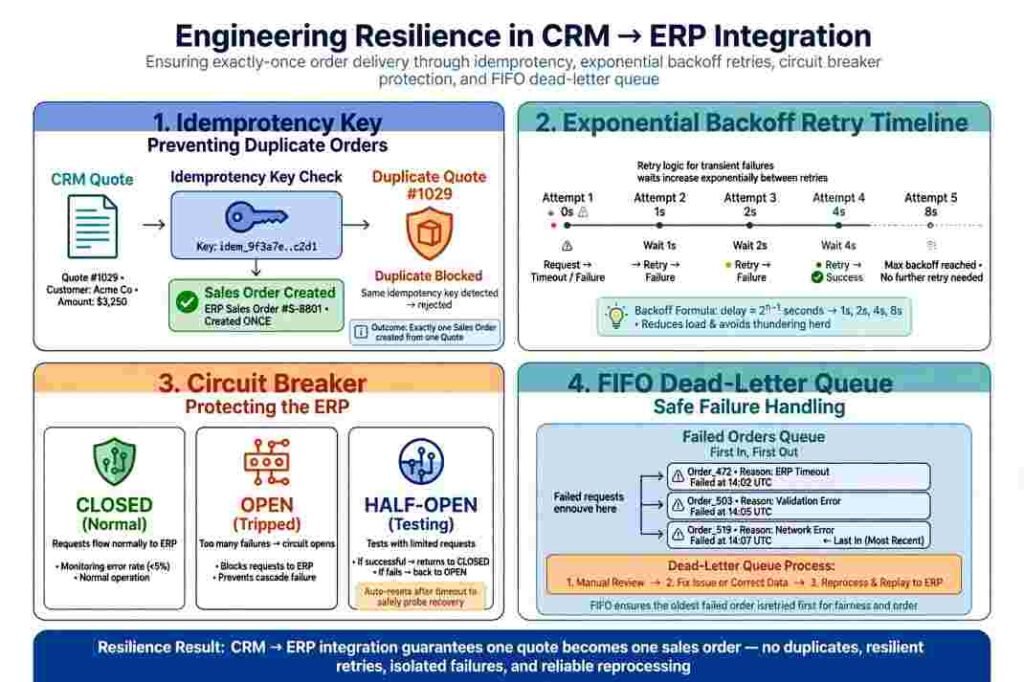
When I audit failing Q2C pipelines, ninety percent of revenue leakage stems from poor exception handling rather than bad field mappings. Network blips happen daily, so your middleware must handle failures gracefully without human intervention.
Enforcing Idempotency to Stop Duplicate Orders
If your CRM fires a “Closed Won” event and the ERP times out before sending a 200 OK response, the middleware will retry. Following AWS distributed system idempotency standards, I generate a deterministic composite key in the CRM—combining Quote_ID and Quote_Version—and pass it in the request header. The ERP stores processed keys in a fast cache for 72 hours. If a duplicate key arrives, the ERP ignores the write and returns the original Sales Order ID.
Exponential Backoff, Jitter, and Circuit Breakers
Never configure blind, immediate retries. Classify HTTP errors first so transient timeouts (429, 502, 503, 504) trigger retries, while validation errors (400, 422) fail immediately. For transient errors, space retries exponentially—2 seconds, 4 seconds, 8 seconds—and add randomized jitter (±20% variance) so hundreds of queued orders do not hammer a recovering ERP simultaneously.
I also place a circuit breaker on the ERP connector, referencing standard SAP S/4HANA API rate-limit protocols. If error rates exceed 50 percent over sixty seconds, the breaker trips, holds incoming CRM events safely in queue, and sends single health-check probes until the ERP stabilizes.
Designing FIFO Dead-Letter Queues with CRM Write-Backs
When a payload exhausts its retry budget or fails schema validation, route it to a Dead-Letter Queue (DLQ) enriched with the failed step, error code, timestamp, and end-to-end correlation ID. Always enforce First-In, First-Out (FIFO) ordering per customer account so a sales order never replays ahead of a pending customer address update.
Most importantly, write plain-English error messages back to a custom status field on the CRM quote. Empowering sales ops to fix a missing tax ID directly in the CRM eliminates eighty percent of engineering support tickets.
Four Non-Negotiable Data Governance Rules
Before writing a single line of integration code, lock down these four governance rules across your sales and finance teams:
- Assign One System of Record Per Object: The CRM owns leads, contacts, and opportunities; the ERP owns SKUs, tax rules, credit limits, and invoices. Never allow bidirectional edits on the same field without clear conflict resolution.
- Standardize Product Identifiers: Enforce identical SKU codes and UUIDs across CPQ and ERP catalogs to prevent line-item mapping failures during order ingestion.
- Decouple Sales and Financial States: Keep CRM opportunity stages separate from ERP billing states so an account can remain active for renewals while finance resolves a disputed invoice.
- Run Daily Reconciliation Sweeps: Schedule a lightweight nightly audit comparing all “Closed Won” CRM quotes from the past 24 hours against created ERP orders to catch silently dropped webhooks.
Frequently Asked Questions
1. What is CRM to ERP quote-to-cash integration?
It is an automated data pipeline that connects front-office sales quoting (CRM/CPQ) with back-office order fulfillment, invoicing, and accounting (ERP) to eliminate manual data entry.
2. Which system should be the master for product pricing in Q2C?
Your ERP should own base SKUs, cost structures, and tax rules, while your CRM/CPQ layer manages promotional discounting and commercial bundles.
3. How do you prevent duplicate sales orders in ERP integrations?
Pass a unique composite idempotency key (such as Quote ID plus Version Number) with every payload so the ERP rejects duplicate retries automatically.
4. Should Q2C integrations use real-time webhooks or batch syncs?
Use event-driven webhooks for time-sensitive order creation, synchronous APIs for live credit or stock checks, and scheduled batches for nightly catalog updates.
Stop Duct-Taping Your Revenue Pipeline
Treating quote-to-cash integration as a simple data-mapping task guarantees painful fire drills every quarter-end. When you separate your architectural layers, enforce idempotency keys, and surface clear sync errors directly inside your CRM, finance closes the books faster and sales reps stay focused on selling.
Audit your current “Closed Won” webhook flow this week—if it lacks a composite idempotency key and a FIFO dead-letter queue, make those two upgrades your immediate engineering priority.