
Automating lab results delivery from diagnostic APIs to patient portals eliminates the manual PDF uploads and sluggish SFTP batch jobs that frustrate patients and overload clinic staff. When I first audited a multi-clinic diagnostic integration three years ago, patients waited an average of 22 minutes—and sometimes four hours—after pathologist sign-off just to see a routine blood panel. By switching that pipeline to event-driven webhooks and structured HL7 FHIR APIs, we dropped end-to-end delivery latency to 14 seconds.
Why Legacy Batch Transfers Fail Modern Clinical Workflows
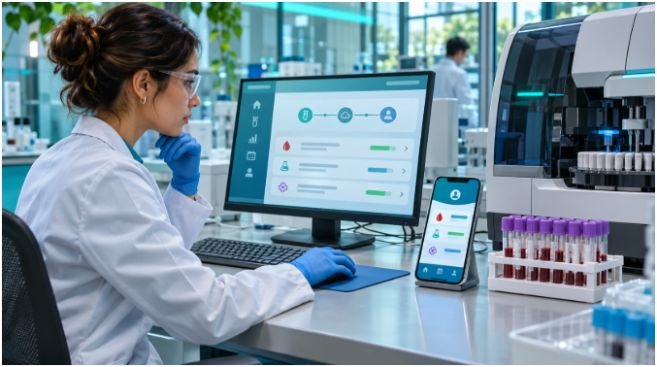
Most legacy Laboratory Information Systems (LIS) still export results via scheduled cron jobs every 15 to 60 minutes. If a batch script stalls at 4:45 PM on a Friday, urgent metabolic panels sit unseen over the weekend. Worse, flat PDF attachments trap clinical data inside static documents. Patients cannot graph their HbA1c trends over time, and ordering physicians cannot query discrete values inside their EHR.
To prevent data silos in healthcare SaaS, diagnostic pipelines must treat lab results as real-time structured events rather than static files. When a pathologist validates a report, downstream portals need immediate, machine-readable payloads.
Four-Stage Event-Driven Pipeline Architecture
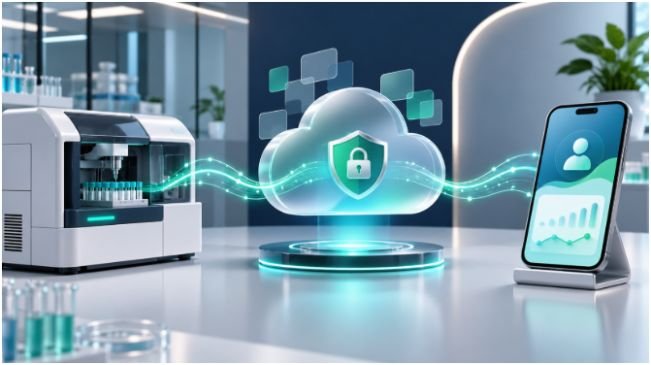
In my production deployments, I decouple the LIS from the patient-facing application using four sequential stages backed by a persistent message queue.
1. Webhook Triggers on Pathologist Sign-Off
Instead of polling the LIS database every few minutes, I configure the LIS to fire an outbound HTTPS POST webhook the exact second a report status shifts to final. An API gateway receives this payload, validates the cryptographic signature, and immediately writes the raw message to a queue like RabbitMQ or AWS SQS. This queue acts as a shock absorber during peak morning lab hours when thousands of specimens clear analyzers simultaneously.
2. HL7 FHIR R4 and LOINC Data Mapping
Raw LIS outputs rarely match what a modern mobile portal expects. Older hospital analyzers emit pipe-delimited HL7 v2 ORU^R01 messages, while newer cloud labs send proprietary JSON. My middleware layer normalizes both formats into standardized HL7 FHIR R4 Diagnostic Report resources paired with discrete Observation entries.
During this translation step, the engine maps proprietary lab test codes to universal LOINC identifiers. Standardizing on LOINC ensures that a “Serum Glucose” test from Quest maps identically to the same test from an in-house clinic analyzer.
3. Deterministic Master Patient Index (MPI) Matching
Routing a lab report to the wrong patient chart is a severe HIPAA breach and a clinical safety hazard. Before writing any record to the portal, my integration layer queries the Master Patient Index using deterministic matching rules.
I require an exact match across at least three identifiers—typically Medical Record Number (MRN), date of birth, and legal last name—before linking the report. Any payload failing this check drops into a Dead-Letter Queue (DLQ) for manual registration review rather than guessing with fuzzy logic.
4. Automated Clinical Triage and Multi-Channel Alerts
Not every lab result should trigger an instant push notification to a patient’s phone. Under federal rules guided by the Office of the National Coordinator for Health Information Technology (ONC), patients have a right to prompt electronic access, yet clinics still need safe workflows for critical values.
I build an automated triage rules engine directly into the middleware to inspect every Observation.interpretation flag:
- Routine and Normal Values: The engine commits the FHIR bundle straight to the portal database and triggers an automated SMS, email, or WhatsApp alert.
- Critical or Panic Values: If potassium or troponin levels breach critical thresholds, the engine fires an immediate high-priority webhook to the ordering physician’s on-call pager while applying a clinic-approved hold window before patient notification.
Build vs. Buy: Choosing Your Integration Stack

Choosing between an out-of-the-box portal, integration middleware, or custom code depends entirely on your engineering bandwidth and LIS age. Teams looking for no-code orchestration often ask about a HIPAA compliant Zapier alternative, though high-volume clinical routing usually demands dedicated healthcare middleware.
| Approach | Best For | Key Architecture Trade-offs |
| Native LIS Portals (e.g., CrelioHealth, Epic MyChart) | Single-location clinics wanting zero custom engineering | Fast launch with built-in SMS alerts, but minimal UI customization and rigid triage rules. |
| Healthcare Integration Engines (e.g., Mirth Connect, Redox) | Multi-site networks connecting legacy HL7 v2 labs to modern apps | Handles complex LOINC mapping and queue retries out of the box, though licensing scales with volume. |
| Custom FHIR Middleware (Node.js/Python + FHIR Server) | Digital health startups building proprietary patient apps | Full control over triage logic, custom mobile UX, and payload caching, requiring dedicated DevOps maintenance. |
Security Controls and HIPAA Compliance Guardrails
Every hop between a diagnostic analyzer and a patient’s smartphone transmits Electronic Protected Health Information (ePHI). I enforce four non-negotiable security controls across every lab integration I architect:
- HMAC-SHA256 Webhook Verification: Every incoming LIS webhook must carry an HMAC signature header and a five-minute timestamp window. My gateway rejects unsigned requests or stale timestamps immediately to block replay attacks.
- TLS 1.3 and OAuth 2.0 Scopes: All API traffic runs over TLS 1.3. Outbound writes to the patient portal authenticate via OAuth 2.0 client credentials restricted strictly to system/DiagnosticReport.write and system/Observation.write scopes.
- Zero-PHI Push Notifications: Text messages and emails never contain test names, analyte values, or diagnostic summaries. Notifications state only, “Your new lab report is ready to view,” alongside an authenticated deep link into the portal.
- Immutable Audit Trails: To satisfy the HHS HIPAA Security Rule audit control standards, the middleware logs every ingestion timestamp, MPI match score, triage hold, and patient view event into write-once cloud storage.
Four-Phase Production Rollout Protocol
Rushing a diagnostic integration straight into live traffic risks flooding patients with duplicate alerts or misrouted reports. I follow a strict six-week rollout sequence to validate data integrity before flipping the switch.
During Weeks 1 and 2, I stand up sandbox endpoints and map LOINC codes for the top 80% highest-volume panels—usually Complete Blood Counts (CBC), Comprehensive Metabolic Panels (CMP), and lipid profiles.
In Weeks 3 and 4, I run the pipeline in shadow mode against live production LIS traffic while suppressing all patient notifications. Shadow testing lets me audit MPI match rates (I target 99.9% accuracy) and verify that critical panic values trigger physician escalations properly.
In Week 5, I enable live automated delivery for a single clinic location covering low-risk wellness panels. Once latency holds steady under 60 seconds with zero DLQ anomalies, Week 6 opens full production cutover across all remaining diagnostic departments.
Stop Making Patients Refresh Empty Portals
Patients anxious about blood work should never have to call your front desk asking if their faxed PDF arrived yet. Start by auditing your current LIS export method today: if your system still relies on scheduled SFTP batch drops, configure a single sandbox webhook listener for DiagnosticReport events and run a two-week shadow test. That single architectural shift eliminates manual transcription bottlenecks and puts verified results in your patients’ hands within seconds.
Frequently Asked Questions
1. What is the best API standard for sending lab results to a patient portal?
HL7 FHIR R4 is the industry standard because it structures discrete Observation values alongside DiagnosticReport metadata for easy mobile rendering.
2. How do you prevent critical lab results from alarming patients before a doctor sees them?
You configure middleware triage rules to inspect Observation.interpretation flags and trigger immediate clinician alerts alongside a brief patient-release hold.
3. Can you include actual lab values inside SMS or email notifications?
No, HIPAA transmission rules prohibit sending unencrypted PHI over standard SMS or email, so alerts must use generic prompts linking to an authenticated portal.
4. How do integration pipelines handle legacy LIS systems that lack REST APIs?
An interface engine like Mirth Connect translates legacy pipe-delimited HL7 v2 ORU^R01 messages into modern RESTful FHIR payloads automatically.