Last year, I audited a multi-specialty clinic group losing nearly 14% of its initial claims to preventable coverage errors. Front-desk coordinators were spending twelve minutes per patient toggling between payer portals and hold queues, yet expired plans still slipped through. Rebuilding that intake workflow by automating insurance eligibility verification via healthcare APIs cut registration-related denials by more than half within sixty days.
Modern healthcare APIs replace manual portal logins with programmatic requests that confirm active coverage and patient out-of-pocket costs in seconds. By connecting Electronic Health Records (EHRs) directly to clearinghouses and payers, engineering and revenue cycle teams catch inactive policies before the clinician ever enters the room.
Why Manual Portal Lookups Still Drain Revenue Cycle Teams
Even clinics with modern digital intake forms often rely on human staff to verify insurance behind the scenes. When a patient uploads a photo of a new insurance card ten minutes before an appointment, manual verification breaks down immediately. Staff either delay the visit or let the patient walk back unverified, shifting financial risk onto the practice.
Automating this checkpoint moves benefit validation upstream to appointment booking and digital check-in. Instead of guessing whether a deductible has been met, your EHR displays exact copays, coinsurance rates, and plan status at the point of care.
How Real-Time Eligibility APIs Translate JSON Into X12 270/271
Under the hood, US health insurers do not speak modern REST. Every electronic eligibility check must adhere to HIPAA-mandated Electronic Data Interchange (EDI) standards governed by the Centers for Medicare & Medicaid Services (CMS). Healthcare APIs act as translators that shield your developers from raw EDI syntax while keeping transactions compliant.
Step 1: Event Triggers and Payload Assembly
In the pipelines I build, three distinct events trigger an automated check: initial online booking, digital intake completion 48 hours prior to care, and kiosk check-in. When any trigger fires, your backend assembles a clean JSON payload containing the patient’s legal name, date of birth, subscriber ID, payer ID, and the rendering provider’s National Provider Identifier (NPI).
If your clinical stack already normalizes FHIR healthcare data, you can map these demographics directly from the HL7 FHIR Coverage resource without writing custom database extractors.
Step 2: Clearinghouse Translation and Payer Routing
Once your application posts that JSON request, the API vendor converts it into an ANSI X12 270 (Eligibility Inquiry) transaction. The clearinghouse validates segment syntax, wraps the payload, and routes it to the target health plan’s gateway. Under CAQH CORE operating rules, compliant payers must process real-time inquiries within strict response-time thresholds—typically returning results in one to six seconds.
Step 3: Parsing the X12 271 Response and EHR Write-Back
The payer replies with an ANSI X12 271 (Eligibility Response) file packed with nested loops and coded benefit segments. Raw 271 strings are notoriously painful to parse manually because carriers format deductible and coinsurance loops differently.
Your API provider normalizes that 271 response back into structured JSON. Your EHR integration then writes active plan details, remaining deductibles, and copays straight into the patient chart. If the payer flags an inactive policy or mismatched member ID, the workflow routes an alert into a billing exception queue for human follow-up.
Real-Time API Checks vs. Overnight Batch Processing

Every clinic I have worked with eventually settles on a hybrid architecture that pairs synchronous API calls with scheduled overnight sweeps. Relying on just one mode leaves operational blind spots.
| Operational Dimension | Real-Time API Checks | Overnight Batch Processing |
| Execution Pattern | Synchronous single-patient REST requests | Asynchronous bulk CSV or X12 file uploads |
| Typical Latency | 1 to 6 seconds per inquiry | Minutes to several hours depending on queue size |
| Primary Use Cases | Walk-ins, live online booking, front-desk check-ins | Auditing next-day or next-week appointment schedules |
| Exception Handling | Instant UI feedback during patient registration | Morning worklists for financial counselors |
Running a bulk batch sweep every night at 2:00 AM clears 85% to 90% of tomorrow’s schedule before staff arrive. Real-time API calls then handle same-day bookings, walk-ins, and any last-minute card updates at the front desk.
Comparing Leading Eligibility APIs: Stedi, Eligible, and pVerify

Choosing an API vendor comes down to your engineering team’s workflow, legacy protocol requirements, and billing volume. When evaluating platforms for an EHR integration, three providers consistently stand out.
Stedi offers the cleanest developer experience for modern engineering teams. You can generate sandbox keys in under two minutes without talking to sales, inspect exact JSON-to-X12 mappings, and use webhooks for asynchronous events. Stedi operates on transparent pay-as-you-go pricing with zero monthly minimums, charging $0.30 per eligibility check at low volumes and scaling down to $0.08 per check above 10,000 monthly transactions. However, it focuses strictly on electronic clearinghouse connections rather than manual portal fallbacks.
Eligible works best when you want to bundle eligibility checks with downstream claims and remittance APIs. Instead of charging per standalone eligibility ping, Eligible prices its patient clearance suite at $0.30 per submitted claim—which includes up to ten eligibility or cost-estimation calls per claim—alongside a percentage-based billing fee. Its OpenAPI specs and SDKs are solid, though the data model assumes you are processing the full revenue cycle through their pipes.
pVerify shines when your EHR must support legacy standards alongside modern web services. Beyond REST and X12 270/271, pVerify natively supports HL7 and FHIR healthcare data interfaces, plus automated portal fallbacks for regional or specialty payers that lack electronic EDI links. Pricing follows traditional SaaS tiers starting around $125 per month for 500 checks under annual contracts, plus a one-time onboarding fee.
Three Production Lessons That Prevent Silent Billing Failures
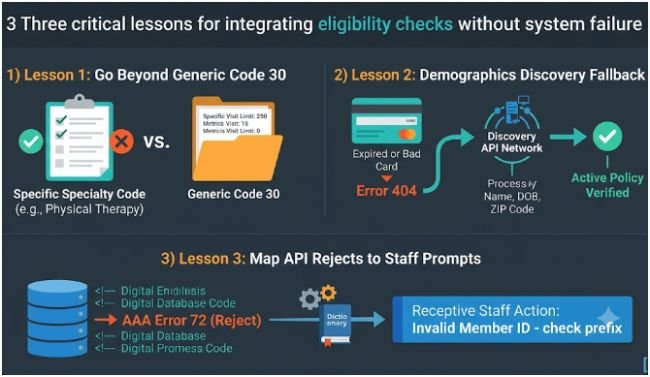
Connecting to a sandbox endpoint takes an afternoon; surviving payer edge cases in production takes deliberate engineering. Three safeguards saved our integrations from silent revenue leakage.
Stop Defaulting to Service Type Code 30
Most starter tutorials send X12 Service Type Code 30 (Health Benefit Plan Coverage) on every request. That is a mistake. Code 30 returns generic medical benefits, which often hides carve-outs for behavioral health, physical therapy, chiropractic care, or advanced imaging. Always pass the exact specialty service type code tied to the scheduled appointment type so the payer returns accurate visit limits and specialty copays.
Pair Primary Checks With Insurance Discovery Fallbacks
Patients routinely hand over expired cards or transpose subscriber digits during mobile intake. When a standard 270 inquiry returns a subscriber-not-found error, do not immediately force staff onto the phone. Trigger an automated insurance discovery endpoint as a fallback. Discovery APIs query national payer networks using only patient demographics—name, date of birth, and address—to locate active commercial or Medicaid coverage behind the scenes.
Lock Down HIPAA Compliance and AAA Error Routing
Every eligibility payload contains Protected Health Information (PHI). Before transmitting live patient data, execute a formal Business Associate Agreement (BAA) with your API vendor under HHS HIPAA guidelines and enforce TLS encryption in transit and AES-256 encryption at rest.
Just as importantly, map X12 AAA reject reason codes into plain-English prompts for front-desk staff. Showing a receptionist AAA Error 72 stops registration cold; translating that code into “Invalid Member ID — verify prefix on card” lets them fix the typo while the patient is still standing at the desk.
Frequently Asked Questions About Eligibility Verification APIs
1. How fast does an automated insurance eligibility API return coverage details?
Most real-time API checks return parsed coverage and deductible data within one to six seconds.
2. What is the difference between X12 270 and X12 271 transactions?
The X12 270 is the outbound eligibility request sent to the insurer, while the X12 271 is the inbound coverage response.
3. Can healthcare APIs verify coverage for patients who forgot their insurance card?
Yes, insurance discovery APIs locate active policies using only patient demographics like legal name, birth date, and ZIP code.
4. Do I need a HIPAA Business Associate Agreement to use an eligibility API?
Yes, any API vendor transmitting or parsing patient eligibility data must sign a BAA before handling live PHI.
Ship the Check Before the Patient Sits Down
Chasing denied claims ninety days after a visit is the most expensive way to discover a lapsed insurance policy. By automating insurance eligibility verification via healthcare APIs, you turn coverage validation from a back-office bottleneck into an invisible, three-second step at registration.
Start small this week: grab a free sandbox key, wire a single real-time check into your appointment booking webhook using specialty-specific service type codes, and measure how many bad member IDs you catch before Monday morning’s schedule begins.