
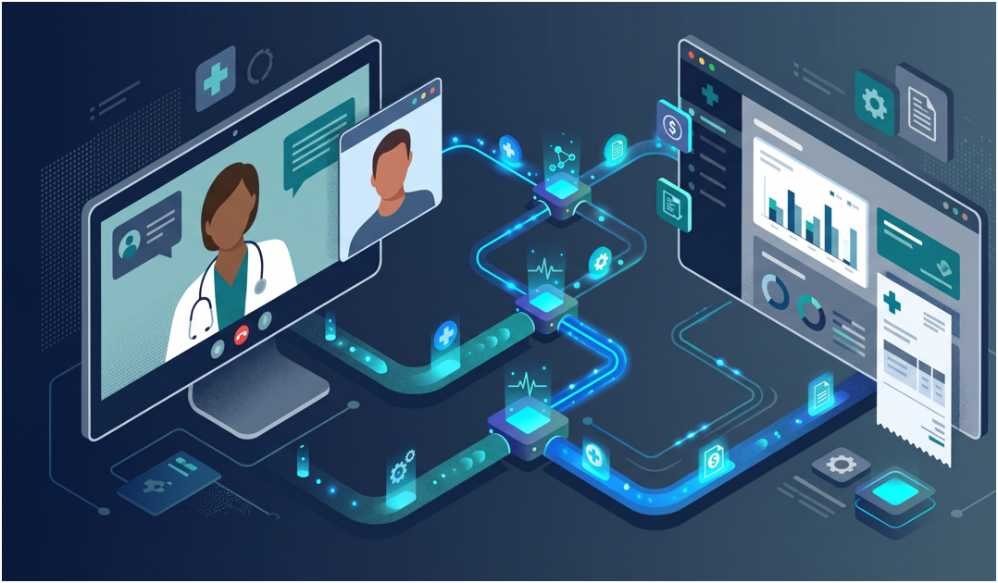
Last quarter, I audited a virtual care network losing $42,000 a month simply because their video platform and revenue cycle management (RCM) engine refused to speak the same language. Staff manually re-keyed visit durations, frequently misapplied Place of Service codes, and watched clean claims bounce back as denials. Implementing a custom API integration for telehealth platforms and billing software eliminated those manual handoffs within six weeks.
When you connect virtual care tools directly to electronic health records (EHRs) and billing engines, clinical events automatically trigger financial actions. Instead of chasing spreadsheets after every clinic block, your engineering pipeline validates insurance, maps clinical codes, and submits clean claims seconds after a clinician clicks “End Call.”
Why Off-the-Shelf Connectors Break Telehealth Revenue Cycles

Most plug-and-play plugins work fine for basic appointment reminders, yet they crumble under real-world reimbursement rules. Payers enforce strict distinctions between audio-only visits, home-based video consultations, and clinic-originated telehealth. Generic webhooks rarely capture the granular session metadata needed to satisfy those rules.
In my experience building architectures for scaling healthcare SaaS products, revenue leakage almost always stems from three gaps:
- Missing session telemetry: Billing rules often tie reimbursement tiers to exact elapsed minutes, which generic calendar webhooks fail to pass.
- Static modifier logic: A single clinician might treat patients located at home (POS 10) and at a satellite facility (POS 02) within the same afternoon.
- Disconnected intake data: If you do not automate patient intake workflows upfront, stale subscriber IDs flow straight into your clearinghouse.
Four Core Workflows in a Telehealth-to-Billing Pipeline

A resilient virtual care revenue pipeline orchestrates four distinct operational layers from booking to final settlement.
Real-Time Payer Eligibility Verification
Before a patient ever enters a virtual waiting room, your API layer should query payer databases to confirm active coverage. Passing subscriber details through an automated eligibility check returns remaining deductibles, copay tiers, and explicit telehealth benefit flags. Catching an expired policy 24 hours before the visit prevents uncollectible bad debt later.
Bi-Directional Encounter Syncing
Once a consultation begins, bi-directional webhooks keep patient demographics, clinician identifiers, and visit statuses (arrived, in-progress, finished) synchronized across the telehealth UI and the EHR. If a patient reschedules inside the virtual portal, the practice management schedule updates immediately without human intervention.
Automated CPT, Modifier, and POS Coding
The moment a session concludes, clinical documentation and call logs trigger transformation rules that assign standard billing codes. According to the AAPC guide on telehealth Place of Service codes, payers require POS 10 when a patient receives care at home and POS 02 when the patient is outside the home. Your API rules engine pairs these POS indicators with Modifier 95 for synchronous audio-video visits or Modifier 93 for audio-only encounters.
Claims Transmission and Instant Copay Capture
After coding validation passes, the billing API formats the encounter into an electronic claim and routes it to your clearinghouse. Simultaneously, an embedded payment gateway processes the patient’s verified copay inside the post-visit summary screen, posting the payment ledger entry directly back to your RCM database.
Technical Standards and Sample FHIR R4 Payload Mapping

Modern healthcare interoperability relies on standardized schemas so cloud video apps can communicate reliably with legacy hospital billing software.
Bridging HL7 FHIR R4 with Legacy X12 EDI
Cloud-native telehealth platforms typically exchange JSON payloads structured around the HL7 FHIR R4 Encounter specification alongside diagnoses coded in SNOMED CT or ICD-10. However, legacy RCM platforms and insurance clearinghouses still process batch transactions via ANSI X12 EDI—specifically X12 837 for professional claims and X12 835 for electronic remittance advice. Your middleware layer acts as the translator between real-time REST APIs and batch EDI engines.
Production JSON Mapping: Encounter to Claim
When I architect these pipelines, I enforce a strict transformation rule: a Claim resource is only generated when an Encounter reaches status: “finished” with a verified virtual class code (VR). Below is a simplified production mapping showing how a completed telehealth visit translates into an HL7 FHIR R4 Claim payload:
JSON
{
“resourceType”: “Claim”,
“id”: “clm-tele-88392”,
“status”: “active”,
“type”: {
“coding”: [{ “system”: “http://terminology.hl7.org/CodeSystem/claim-type”, “code”: “professional” }]
},
“use”: “claim”,
“patient”: { “reference”: “Patient/pat-44102” },
“created”: “2026-11-16T10:26:12Z”,
“provider”: { “reference”: “Organization/org-virtual-clinic-01” },
“diagnosis”: [
{
“sequence”: 1,
“diagnosisCodeableConcept”: {
“coding”: [{ “system”: “http://hl7.org/fhir/sid/icd-10”, “code”: “J06.9” }]
}
}
],
“item”: [
{
“sequence”: 1,
“diagnosisSequence”: [1],
“productOrService”: {
“coding”: [{ “system”: “http://www.ama-assn.org/go/cpt”, “code”: “99214” }]
},
“modifier”: [
{ “coding”: [{ “code”: “95”, “display”: “Synchronous Telemedicine Service” }] }
],
“locationCodeableConcept”: {
“coding”: [{ “code”: “10”, “display”: “Telehealth Provided in Patient’s Home” }]
},
“servicedPeriod”: {
“start”: “2026-11-16T10:00:00Z”,
“end”: “2026-11-16T10:25:00Z”
},
“net”: { “value”: 135.00, “currency”: “USD” }
}
]
}
HIPAA Security and BAA Guardrails
Transmitting Protected Health Information (PHI) across third-party APIs demands uncompromising security controls. Every endpoint must enforce OAuth 2.0 or SMART on FHIR authorization, TLS 1.3 encryption in transit, and immutable audit logs. Per HHS.gov Business Associate guidance, any cloud vendor, webhook router, or middleware platform that transmits or maintains PHI on your behalf must sign a Business Associate Agreement (BAA) before a single test record enters production.
Direct Custom APIs vs. Integration Middleware

Choosing between point-to-point custom code and an integration engine depends on how many EHR and billing endpoints you support.
| Architecture Factor | Direct Custom APIs | Integration Engines / Middleware |
| Best Fit | Proprietary platforms connecting to 1–2 core RCM systems | Multi-clinic networks integrating across 5+ diverse EHRs |
| Control & Logic | Complete ownership over custom split-billing and UI workflows | Standardized transformation pipelines with configurable rules |
| Upfront Engineering | Moderate build time for single-vendor authentication and mapping | Fast initial setup using pre-built FHIR and HL7v2 parsers |
| Ongoing Maintenance | High burden when vendor APIs or payer modifiers update | Managed schema updates, dead-letter queues, and retry logic |
| Cost Structure | Internal engineering hours without middleware licensing | Recurring platform subscription or per-transaction fees |
My 4-Step Implementation Roadmap for Zero-Drop Deployments
Follow this engineering sequence to launch your pipeline without disrupting active clinic billing:
- Map triggers and payer rules: Document every webhook event (visit.completed, note.signed) and build a decision table mapping patient location and call modality to exact CPT, POS, and modifier combinations.
- Configure sandbox authentication: Provision OAuth 2.0 credentials, mutual TLS certificates, and IP allowlists inside both your telehealth and RCM sandbox environments.
- Build idempotent retry queues: Network blips happen. Attach a unique idempotency key to every encounter payload and route failed webhooks into a dead-letter queue so you never double-bill a patient.
- Run shadow-mode edge testing: Before flipping the production switch, run real encounters through the pipeline in shadow mode for two weeks. Audit how the logic handles dropped calls, split self-pay invoices, and zero-dollar follow-ups.
Frequently Asked Questions
1. How long does a custom telehealth billing API integration take?
A single point-to-point integration between a modern FHIR-ready telehealth platform and one RCM system typically takes 4 to 8 weeks, while multi-EHR middleware deployments require 10 to 16 weeks.
2. What is the difference between POS 02 and POS 10 in telehealth APIs?
POS 10 indicates the patient received telehealth services while located in their home, whereas POS 02 applies when the patient is at a facility or location other than their home.
3. Do I need a BAA for middleware connecting telehealth and billing tools?
Yes, federal HIPAA rules require a signed Business Associate Agreement with any middleware or API vendor that routes, transforms, or logs Protected Health Information.
4. How do billing APIs handle dropped telehealth video calls?
Well-designed API pipelines inspect actual media-server connection timestamps rather than scheduled calendar slots, automatically routing sessions below minimum billable duration thresholds to manual review or audio-only modifier rules.
Stop Letting Orphaned Encounters Bleed Your Margins
Every unbilled virtual visit or rejected modifier claim is revenue your clinical team already earned. Start by auditing your last 100 telehealth claim denials to identify which missing data fields—patient location, exact call duration, or subscriber verification—caused the rejection. Once you map those exact gaps to your FHIR Encounter webhooks, a custom API integration for telehealth platforms and billing software turns your virtual care platform into a predictable, self-reconciling revenue engine.



One thought on “Custom API Integration for Telehealth Platforms and Billing Software”