A single poorly configured API can expose thousands of student records without anyone breaking into a school’s main database. The problem is not always sophisticated hacking. Sometimes, an application simply receives more information than it should.
Understanding how to secure student data during API transfers is essential for schools connecting student information systems, learning platforms, attendance applications, and educational software.
Effective protection requires encrypted connections, verified identities, restricted permissions, secure authentication tokens, and continuous monitoring.
More importantly, school administrators must understand exactly which student records their technology partners can access and why that access is necessary.
1. Encrypt Student Information Before Transmission
Encryption ensures that intercepted network traffic cannot easily reveal confidential student information.
Use HTTPS and Modern TLS Protocols
Every API exchanging sensitive educational records should use HTTPS with properly configured Transport Layer Security (TLS).
TLS protects information against eavesdropping and unauthorized modification while traveling between systems. The National Institute of Standards and Technology provides guidance on secure TLS configuration, including TLS 1.2 and TLS 1.3.
Schools should disable outdated encryption protocols, verify digital certificates, and prevent applications from bypassing certificate validation.
Protect Highly Sensitive Fields Separately
Transport encryption protects information during transmission but does not prevent an authorized receiving system from viewing it.
For exceptionally sensitive information, additional field-level encryption using an approved algorithm such as AES-256 may be appropriate. Encryption keys should remain separate from encrypted records, with access restricted to authorized systems.
2. Strengthen API Authentication and Credential Security
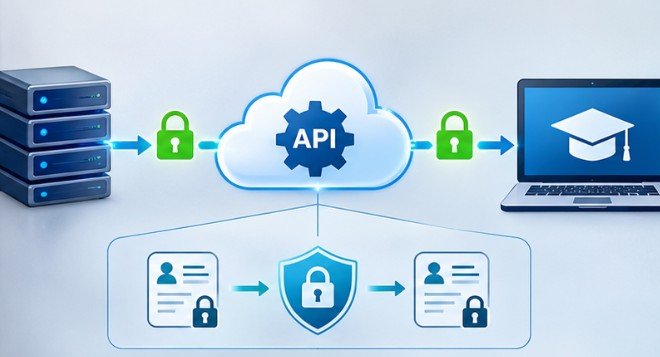
An encrypted connection is useful only when the receiving application is trustworthy. Authentication establishes which application is requesting student data.
Implement OAuth 2.0 and Short-Lived Tokens
OAuth 2.0 provides a standardized framework for obtaining restricted access tokens. For server-to-server integrations, the client credentials flow can authenticate approved applications without sharing individual staff passwords.
JSON Web Tokens (JWTs) can carry authorization information, but applications must validate token signatures, expiration dates, issuers, and intended audiences. JWTs are a token format, not an independent replacement for secure authentication.
Keep API Secrets Outside Application Code
Schools should never store API passwords, private keys, or client secrets directly in publicly accessible repositories.
Use a dedicated secrets manager with controlled access, credential rotation, and audit capabilities.
Revoke compromised credentials immediately and replace unnecessary permanent tokens with short-lived alternatives.
3. Restrict Access to Only the Required Student Records
Authentication proves an application’s identity. Authorization determines what that application can actually do. This difference is particularly important in educational integrations.
Apply Role-Based and Attribute-Based Permissions
Role-Based Access Control (RBAC) assigns permissions according to defined responsibilities.
Attribute-Based Access Control (ABAC) adds contextual rules, such as school location, student enrollment, or organizational relationships.
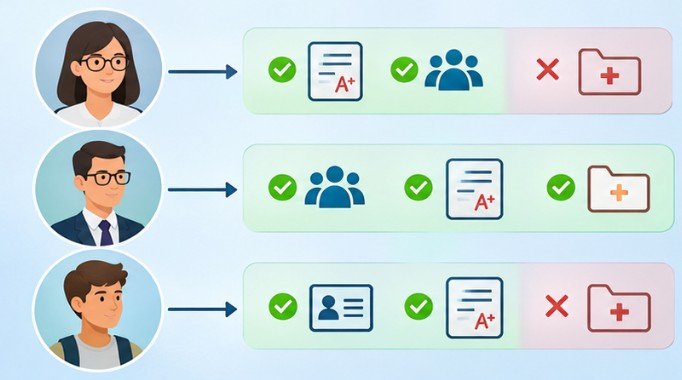
For example, an attendance application might receive permission to retrieve student identifiers and attendance records without accessing counseling notes or unrelated academic information.
Use Claim Sets and Data Profiles
The Ed-Fi Alliance’s API security documentation explains how educational integrations can combine authentication, claim sets, relationship-based restrictions, and profiles. Claim sets govern permitted operations, while profiles can limit accessible data fields.
This allows administrators to control not just which records an application accesses, but which information within those records becomes visible.
4. Minimize Data Sharing Between Educational Platforms
One of the simplest security improvements is reducing the amount of information transferred. Consider a reading application that requires student names, grade levels, and classroom assignments.
Sending complete academic histories, home addresses, and medical information would create unnecessary exposure. Instead, configure API responses to return only the required fields.
Schools should also establish retention schedules so external applications do not preserve student information indefinitely.
Before transferring records to analytics software, AI services, or other third-party platforms, verify their privacy agreements, data usage restrictions, and deletion procedures. Data minimization reduces potential damage even when another security control fails.
5. Prevent API Abuse Through Validation and Rate Limits
Secure authentication does not eliminate vulnerabilities in API endpoints. Attackers may attempt to manipulate student identifiers, submit malicious inputs, or overwhelm applications with automated requests.
Validate Every Request
Use schema validation to check expected data types, formats, lengths, and permitted values. Parameterized database queries help prevent SQL injection, while output encoding reduces cross-site scripting risks.
Most importantly, verify that every requested student record belongs within the application’s authorized scope. The OWASP API Security Top 10 identifies broken object-level authorization, broken authentication, and improper property-level authorization among major API vulnerabilities.
Control Excessive API Requests
Rate limiting restricts how frequently an application can access an endpoint. Schools can implement request quotas, traffic monitoring, pagination limits, and automated blocking for suspicious activity.
When a client exceeds its permitted request threshold, the API can return an HTTP 429 Too Many Requests response. However, rate limiting should complement authorization rather than replace it.
6. Monitor Transfers and Prepare for Security Incidents
Even carefully secured integrations require ongoing oversight. Maintain centralized audit logs recording application identities, request times, accessed resources, response outcomes, and unusual activity.
Avoid storing complete student records, access tokens, or unnecessary PII inside those logs.
Security teams should investigate unexpected bulk downloads, repeated authorization failures, and access attempts outside approved application behavior.
A response plan should identify who can disable integrations, revoke credentials, contact vendors, and assess notification obligations. Regular security reviews help identify forgotten integrations and permissions that remain active after contracts expire.
7. Address FERPA and Vendor Responsibilities
Technical safeguards must work alongside educational privacy requirements. FERPA generally restricts disclosure of personally identifiable information from education records unless consent or an applicable exception permits disclosure.
The Department of Education’s FERPA guidance on school officials explains conditions under which contractors may receive education records without individual consent under the school-official exception.
These conditions include appropriate institutional functions, direct school control, and restrictions on information reuse and redisclosure.
Schools should review vendor contracts for permitted data uses, subcontractor controls, incident reporting, retention, and deletion requirements. State student privacy laws may impose additional obligations.
8. A Practical API Security Checklist for School IT Teams
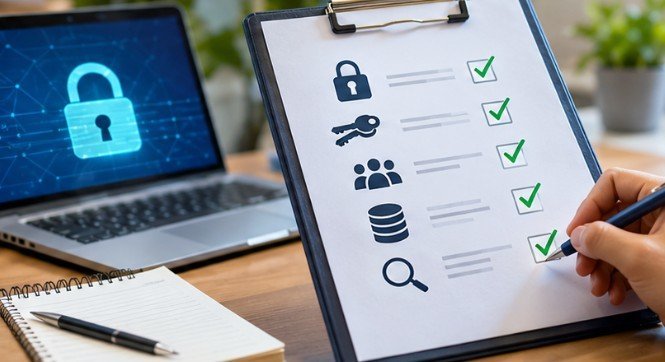
Before activating a new educational integration, administrators can follow this eight-step verification process:
- Map data flows: Identify every student information field entering or leaving the system.
- Verify encryption: Confirm HTTPS, valid certificates, and secure TLS configurations.
- Review authentication: Check token expiration, credential storage, and revocation procedures.
- Test authorization: Confirm applications cannot retrieve records belonging to unrelated students or schools.
- Inspect API responses: Remove unnecessary personal information and sensitive fields.
- Evaluate vendor agreements: Verify FERPA-related responsibilities and applicable state requirements.
- Enable monitoring: Configure rate limits, security alerts, and appropriate audit logging.
- Run negative tests: Attempt expired-token requests, unauthorized record access, malformed inputs, and excessive requests in an approved testing environment.
A useful evaluation involves creating two test accounts associated with different schools. Attempt to retrieve one school’s records using the other school’s credentials. The system should deny unauthorized access without exposing student information. Repeat this test after permission changes, vendor updates, and major system upgrades.
Frequently Asked Questions
1. What is the safest way to transfer student data between systems?
Use HTTPS with modern TLS, OAuth 2.0 authentication, narrowly scoped permissions, minimal data sharing, and continuous audit monitoring.
2. Does FERPA require encryption for student API transfers?
FERPA does not specify a particular encryption protocol. However, encryption is an important safeguard for protecting student education records and supporting responsible data security practices.
3. Can API security prevent unauthorized student record access?
Proper authentication, object-level authorization, access restrictions, and monitoring significantly reduce unauthorized access risks, although no security architecture eliminates every vulnerability.
4. How often should schools review API permissions?
Review permissions before deployment, after significant changes, when contracts change, and periodically according to institutional risk policies. Revoke unnecessary access promptly.
Make Student Privacy Part of Every Integration
Learning how to secure student data during API transfers begins with recognizing that every connection creates both an opportunity and a responsibility.
Educational technology can simplify enrollment, improve communication, and reduce repetitive administrative work. Those benefits should never depend on unnecessary exposure of personal information.
Schools need more than encrypted connections. They need carefully managed identities, meaningful authorization rules, accountable vendors, and reliable monitoring.
The strongest approach is to verify every integration before deployment and reassess it throughout its lifecycle.
A secure educational API should accomplish its intended task while revealing nothing beyond what that task genuinely requires.