
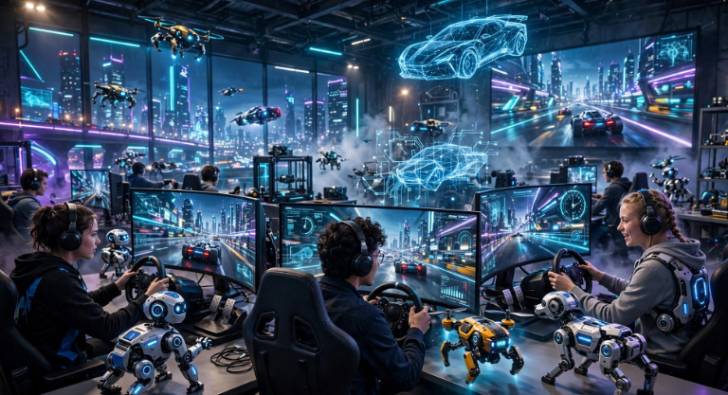
I have always believed the best games are the ones that make you forget you are learning something valuable. When a game feels like a challenge instead of a classroom lesson, curiosity takes over naturally.
That is exactly what makes esports acceleration-city such an interesting concept. Instead of focusing only on racing, this game combines driving, problem-solving, coding, and robotics into a digital experience designed to make STEM skills more engaging.
Created through Carnegie Mellon University’s Robotics Academy and CS2N ecosystem, Acceleration City is a browser-based driving and coding adventure where players explore a digital environment, control vehicles, and work with a programmable robot companion called a CoBot.
For students who enjoy games but may not immediately connect with traditional programming lessons, this type of interactive experience creates a completely different way to build technology skills.
What Makes Esports Acceleration-City Different From Regular Racing Games?
Most racing games are designed around speed, competition, and entertainment. You choose a vehicle, master the controls, and try to beat opponents. Esports acceleration-city adds another layer by introducing programming and strategic thinking into the experience.
Instead of only reacting quickly, players must think ahead. They need to understand how actions affect outcomes, solve challenges, and use logic to complete objectives.
That combination creates a unique balance between gaming excitement and educational value. The player is not just driving through a virtual world; they are learning how systems work.
The game belongs to a growing category of educational technology that uses gameplay as a tool for teaching. Carnegie Mellon’s CS2N platform focuses on computer science, robotics, and STEM learning through interactive resources and virtual experiences.
How Does Esports Acceleration-City Help Players Learn Coding Skills?
The biggest strength of esports acceleration-city is that it introduces coding concepts without making them feel intimidating.
Many beginners see programming as a complicated subject filled with unfamiliar terms. A game-based environment changes that experience because players learn through experimentation.
When you program a virtual robot or create instructions for completing challenges, you immediately see the result. If something works, you understand why. If something fails, you adjust and try again.
This process builds computational thinking, which is one of the most valuable skills in modern technology careers.
Players begin practicing concepts like planning, sequencing, problem-solving, and logical decision-making without feeling like they are completing a traditional assignment.
Why Are Racing Games Becoming Popular Tools for STEM Education?
I think racing games are naturally connected to STEM because they involve movement, strategy, timing, and systems thinking.
A racing environment gives players an easy-to-understand goal. Everyone knows what it means to reach a destination faster or overcome obstacles. Educators can use that familiar structure to introduce more complex ideas.
Esports acceleration-city follows this approach by combining a fun digital world with programming challenges. Players stay motivated because they are working toward visible achievements rather than simply memorizing concepts.
This style of learning also matches how many young people interact with technology today. They are comfortable exploring digital spaces, testing ideas, and improving through practice.
Learning Experience Comparison
| Traditional Learning | Game-Based STEM Learning |
| Focuses mainly on instructions | Encourages exploration |
| Mistakes may feel negative | Mistakes become experiments |
| Limited interaction | Immediate feedback |
| Theory-first approach | Practice-first approach |
How Can You Start Playing Esports Acceleration-City?
Getting started with esports acceleration-city is designed to be simple, especially for students who are new to coding.
The first step is finding a compatible browser and accessing the game through the official CS2N Games platform. The game is designed as a digital experience, meaning players do not need expensive robotics equipment to begin exploring.
The second step is understanding the basic controls and objectives. Spend some time exploring the environment instead of rushing through challenges. Learning how the virtual world responds is part of the experience.
The third step is experimenting with programming elements. Try different commands, observe what happens, and adjust your strategy. Coding improves through testing, not perfection.
The fourth step is challenging yourself with more complex tasks. As your confidence grows, focus on creating smarter solutions rather than simply finishing quickly.
This approach helps beginners develop patience and creativity while improving technical skills.
Can Esports Acceleration-City Prepare Students for Future Careers?
Technology careers are changing quickly, and skills like coding, automation, and problem-solving are becoming increasingly valuable.
While a game alone cannot replace formal education, esports acceleration-city can introduce students to concepts that connect with real-world fields like software development, robotics, engineering, and artificial intelligence.
While a game alone cannot replace formal education, esports acceleration-city can introduce students to concepts that connect with real-world fields like software development, robotics, engineering, and artificial intelligence. Students who become interested in AI can also explore free Character AI alternatives for interactive AI experiences to see how conversational technology is being used beyond traditional classroom environments.
The most important benefit is confidence. Many students avoid technology because they believe programming is only for experts.
A game that allows them to experiment safely can change that mindset. They begin seeing technology as something they can create rather than something they only consume.
Resources from organizations like Code.org and Carnegie Mellon Robotics Academy also show how interactive learning can support computer science education.
What Role Does Competition Play in Esports Acceleration-City?
Competition has always been a powerful motivator in gaming. Leaderboards, challenges, and achievements encourage players to improve their skills.
The esports-style approach behind esports acceleration-city adds excitement by making learning feel like a personal challenge.
Players can compare strategies, improve their solutions, and develop persistence. These habits are valuable both inside games and outside them.
The competitive element also encourages collaboration. Students can discuss approaches, share ideas, and learn from different problem-solving methods.
Is Esports Acceleration-City Suitable for Beginners?
One thing I appreciate about educational games is that they can welcome people with different skill levels.
A beginner does not need advanced programming experience to start. The learning process happens gradually through exploration and practice.
Esports acceleration-city is especially useful for students who enjoy gaming but have never considered coding before.
The game creates a bridge between entertainment and education, making technology feel approachable rather than overwhelming.
The same idea of using technology to make everyday decisions easier can be seen in other digital tools as well. For example, exploring Yuka app alternatives for smarter product choices can show beginners how technology can support informed decision-making beyond gaming and education.
Teachers and parents can also use experiences like this as conversation starters about careers, creativity, and digital skills.
Frequently Asked Questions
1. What is an esports acceleration-city?
Esports acceleration-city is a digital racing and coding game that combines driving challenges with programming concepts. It was developed through Carnegie Mellon’s educational technology ecosystem.
2. Do I need coding experience to play esports acceleration-city?
No. The game is designed for learners who may be new to programming. Players can learn concepts through experimentation and problem-solving.
3. Is esports acceleration-city only for students?
While it is designed with education in mind, anyone interested in coding, robotics, or creative problem-solving can enjoy the experience.
4. Where can I access esports acceleration-city?
The game is available through CS2N Games resources connected with Carnegie Mellon Robotics Academy.
Final Thoughts
The world of gaming is changing, and esports acceleration-city shows how entertainment and education can work together instead of competing against each other.
I love the idea that a player can start with a simple goal—drive, explore, and complete challenges—and slowly discover programming skills along the way.
The future of learning may not always look like a traditional classroom. Sometimes, it might look like a digital city, a racing challenge, and a curious player ready to experiment.
My personal tip: if you enjoy games, do not underestimate what you can learn from them. The next skill you build while playing could become the foundation for something much bigger.