I stopped scrolling when I first saw a polished video showing a futuristic Apple-branded chamber capable of transporting people across the world. The lighting, presentation, and product design appeared convincing enough to resemble an authentic technology launch. However, a closer inspection revealed a fascinating example of how artificial intelligence, speculative storytelling, and familiar branding can transform fiction into a believable internet rumor.
The Apple Teleport Concept: Everything You Need to Know story is not about a real product currently being developed or sold by Apple. It is a fictional idea popularized through AI-generated videos, edited images, social media posts, and imaginative online articles. Nevertheless, the concept raises worthwhile questions about misinformation, quantum science, spatial computing, and the possible future of digital presence.
What Is the Apple Teleport Concept?
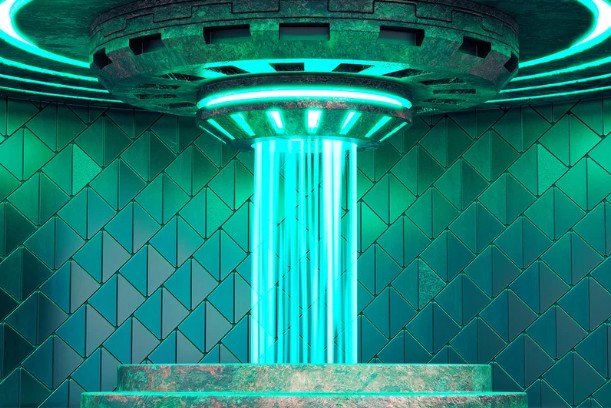
Apple Teleport is imagined as an advanced machine that could move a person or physical object instantly between distant locations. Viral demonstrations commonly show sleek chambers, circular portals, glass enclosures, or minimalist devices designed to resemble Apple products.
Some versions suggest that users could select a destination through an interface and arrive there within seconds. Other interpretations present the technology as a form of digital teleportation, allowing someone’s lifelike three-dimensional presence to appear in another room.
These descriptions belong to speculative fiction. No verified prototype, technical documentation, product page, or official launch announcement confirms that such a machine exists.
Is Apple Teleport Real or Fake?
Apple Teleport is not a real Apple product. The company has not announced a human teleportation machine, published a release date, or demonstrated technology capable of instantly transporting matter.
The confusion developed because modern AI tools can reproduce the visual language associated with major technology launches. Creators can generate convincing stages, product demonstrations, executive-style presentations, voiceovers, audience reactions, and Apple-inspired industrial designs. When these elements appear together in a short video, viewers may mistake an imaginative production for authentic footage.
A real Apple announcement would normally appear through the company’s official newsroom, website, verified channels, and major technology publications. Extraordinary footage appearing only on social media deserves careful verification.
How the Viral Teleport Story Developed
One possible source of confusion is an Apple Education tutorial titled “Make Someone Teleport.” The lesson teaches creators to produce a teleportation illusion through jump cuts and match cuts. It is a video-editing exercise rather than a scientific experiment or product demonstration.
The broader rumor grew as creators combined editing techniques with generative AI. Videos showing fictional Apple inventions circulated across short-form platforms, where dramatic visuals often reach viewers without sufficient context.
Reposts can remove original captions or disclaimers. A clip initially labeled as concept art may consequently return as a supposed leak, prototype demonstration, or upcoming product announcement.
Is the Reported $29 Million Price Genuine?
The widely repeated $29 million price is not an official Apple figure. It forms part of the fictional narrative used in viral content. Because there is no confirmed machine, there can be no legitimate retail price, preorder program, availability schedule, or ownership requirement.
The enormous figure helps the story attract attention. It makes the imaginary device sound exclusive while remaining just believable enough for an experimental technology. However, repetition across numerous posts does not turn an unsupported number into verified information.
How Would the Fictional Device Work?
Most concept videos do not provide a scientifically credible mechanism. They typically rely on glowing portals, scanning systems, quantum terminology, or advanced artificial intelligence without explaining how matter would be disassembled, transmitted, and reconstructed.
Transporting a human would involve recording and reproducing an extraordinarily complex physical system while preserving biological function, identity, and consciousness. Present science offers no practical method for completing that process.
Fictional versions also overlook questions involving energy consumption, transmission errors, destination safety, consent, border controls, security, and the legal status of a reconstructed person.
What Quantum Teleportation Actually Does
Quantum teleportation is a genuine scientific process, but its name can be misleading. It transfers quantum information from one location to another using entanglement, measurement, and classical communication. It does not move a person, ordinary object, or piece of matter through a portal.
The process also cannot be used to send usable information faster than light because classical communication remains necessary. Therefore, successful quantum learning experiments should not be interpreted as early versions of human transportation.
This distinction is one of the most important facts missing from sensational social media posts.
Real Technologies That Inspired the Idea
Spatial Computing and Vision Pro
Spatial computing can make people feel present inside immersive digital environments. Three-dimensional video, realistic avatars, spatial audio, and remote collaboration may eventually create experiences that resemble digital teleportation without moving anyone physically.
LiDAR and Three-Dimensional Mapping
LiDAR sensors can measure depth and build representations of surrounding spaces. Combined with cameras and sophisticated software, this capability can support augmented reality, environmental mapping, and realistic digital reconstruction.
Artificial Intelligence and Apple Silicon
Powerful processors and generative models can create responsive virtual environments, digital people, translated conversations, and realistic simulations. These developments may improve remote presence, but they are fundamentally different from transporting matter.
Potential Benefits of a Hypothetical Teleporter
If safe physical teleportation ever became possible, it could transform travel, emergency response, medicine, education, logistics, and personal relationships. Doctors might reach remote patients rapidly, families could overcome distance, and lengthy journeys could become unnecessary.
Digital presence offers a more realistic near-term path. Immersive telepresence could reduce some business travel, expand access to specialists, and make remote education more engaging without requiring impossible physics.
Major Limitations and Risks
Scientific feasibility remains the largest obstacle. Human teleportation has no established mechanism, while the required precision, information processing, and energy would exceed present capabilities.
A functioning device would also introduce serious privacy and security concerns. Governments would need rules covering identity, immigration, prohibited destinations, criminal misuse, accidents, and system ownership. High costs could worsen inequality if instant transportation were available only to wealthy individuals or powerful institutions.
Environmental benefits would also depend on the machine’s energy source and infrastructure. Replacing aircraft with an extremely energy-intensive system would not automatically reduce environmental damage.
How to Identify a Fake Product Announcement
Before believing a viral technology claim, check whether it appears on the manufacturer’s official website and newsroom. Look for reporting from established publications, independent demonstrations, named researchers, technical evidence, and verifiable patents.
Pay attention to distorted hands, inconsistent reflections, shifting logos, unnatural speech, impossible camera movement, and vague scientific explanations. These details frequently reveal AI-generated media.
Frequently Asked Questions
1. Is Apple developing a teleportation machine?
There is no official evidence that Apple is developing a machine capable of transporting humans or physical objects instantly.
2. Does Apple Teleport have a release date?
No. The product is fictional, so claims involving launches, reservations, demonstrations, or release schedules are unsupported.
3. Is Apple Teleport Concept: Everything You Need to Know based on quantum science?
It borrows quantum terminology, but genuine quantum teleportation transfers quantum information rather than people or physical matter.
4. Could Apple create digital teleportation?
Apple could continue developing immersive communication, spatial computing, realistic avatars, and three-dimensional collaboration. Such experiences might feel like digital teleportation, although users would remain physically in place.
Final Thoughts
When I separate the spectacular visuals from the available evidence, I see Apple Teleport as an internet myth with a genuinely interesting lesson behind it. AI can now make fictional inventions appear credible before viewers have time to question them.
The Apple Teleport Concept: Everything You Need to Know discussion also shows why imagination and accuracy must remain connected. Teleporting people remains science fiction, while quantum communication and immersive telepresence are legitimate areas of progress. I believe the most exciting future will come not from accepting viral claims, but from understanding the real technologies inspiring them.